It’s a familiar, frustrating moment. You pull a brush through your dry hair, and suddenly a soft crackle fills the air. In the mirror, your reflection has transformed; strands of hair defy gravity, floating away from your head in a chaotic halo. It’s the “super saiyan” effect, a universal symbol of a bad hair day. For decades, we’ve blamed humidity, dryness, or simply bad luck. But the true culprit is far more fundamental and fascinating. The battle for smooth hair isn’t fought with conditioners and serums alone; it’s a war waged at the atomic level, a conflict of stolen electrons. And today, the tide is being turned by a weapon disguised as a hair dryer.

The Real Culprit Behind Frizzy Hair: A Story of Stolen Electrons
To understand frizz, we must first shrink ourselves down to the microscopic surface of a single hair strand. Hair is primarily composed of a protein called keratin, which, like all matter, is made of atomsNeutrally charged. These atoms have a core of positive protons orbited by negative electrons. When two different materials touch and then separate, one can literally steal electrons from the other. This phenomenon is known as the triboelectric effect.
The outcome of this atomic theft is determined by the materials’ ranking in the triboelectric series, a hierarchy that dictates which material has a stronger affinity for electrons. Human hair, especially when dry, sits at the positive end of this series, meaning it readily gives up its electrons. Many common plastics, like those used in combs and brushes, are on the negative end, meaning they are electron-hungry.
When you run a plastic comb through your hair, a massive transfer occurs. Billions of electrons are stripped from the surface of your hair and accumulate on the comb. This leaves each hair strand with a net positive charge. And just as the north poles of two magnets push each other apart, these positively charged strands vehemently repel one another. That floating, uncontrollable mess we call frizz and static is nothing more than a physical manifestation of electrostatic repulsion. You aren’t having a bad hair day; you’re experiencing a physics problem.
Introducing the Peacemakers: How Modern Dryers Generate Negative Ions
For years, the solution to wet hair was brute force: intense heat to evaporate water, a method that often caused significant thermal damage to the hair’s delicate keratin structure. But to solve the physics problem of static, a more elegant solution is required. You cannot fight an electrical charge with heat. You must fight it with an opposing charge.
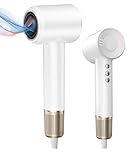
This is the principle behind the ionic technology embedded in advanced hair dryers, such as the Bopcal High Speed Ionic Hair Dryer. At the heart of these devices is a component called a negative ion generator. It’s a tiny, powerful piece of engineering, often employing a method called corona discharge. A very high voltage is applied to a sharp needle-point emitter (or a carbon brush). This intense electric field is strong enough to rip electrons from surrounding air molecules (typically oxygen and nitrogen). The result is a cloud of free electrons that instantly attach to other neutral air molecules, creating a steady stream of negatively charged ions that are propelled out of the dryer along with the high-velocity airflow.
So, while the dryer’s powerful brushless motor is physically blasting water droplets off the hair, the ion generator is simultaneously dispatching a vast, invisible army of peacemakers, each carrying the extra electron needed to restore balance.
The Science of Smooth: Neutralization, Hydration, and the Closed Cuticle
Now that we have a disciplined army of negative ions streaming from the hair dryer, what exactly happens when they meet the positively charged hair? The result is a multi-layered process of neutralization and transformation that occurs in milliseconds.
First, and most obviously, is charge neutralization. Each negative ion that lands on a hair strand donates its extra electron, instantly neutralizing the positive charge at that location. As millions of ions bombard the hair surface, the entire electrostatic field collapses. The repulsive forces vanish, and the hair strands are no longer compelled to push away from each other. They can now lie down smoothly and align together.
Second, a more subtle and profound effect occurs related to hydration. Research in applied physics has shown that negative ions can break apart large clusters of water molecules in the air into smaller, more easily absorbed micro-droplets. When these smaller water clusters are carried by the airflow to the hair, they can more effectively penetrate the hair shaft’s outer layer, the cuticle. This provides deep hydration, which is why hair often feels softer and more moisturized after using an ionic dryer, rather than “baked” and dry.
Finally, this combination of charge neutralization and improved hydration helps the hair cuticles—the microscopic, overlapping scales that form the hair’s protective sheath—to lie flat and closed. A smooth, closed cuticle layer does two critical things: it protects the inner cortex of the hair from damage, and it reflects light more uniformly. This is the physical origin of shine and gloss. The sleek, healthy look is a direct result of microscopic order restored by ionic intervention.

Conclusion: Beyond a Bad Hair Day
The journey from a crackling, static-filled mess to smooth, shining hair reveals a profound shift in personal care technology. We have moved from a brute-force, thermal-based approach to an elegant, physics-based one. A tool like a high-speed ionic dryer is not merely a heat gun; it’s a particle accelerator in miniature, a device that manipulates atomic charges to achieve its goal.
Understanding this science empowers us. We can now recognize that frizz is not a character flaw of our hair but a predictable physical phenomenon. It allows us to appreciate that the quiet hum of a modern dryer is the sound of sophisticated engineering—powerful motors, intelligent heat sensors, and ion generators—working in concert. We are no longer just drying our hair; we are actively managing its electrical and physical state at a microscopic level. And that, in itself, is a beautiful piece of science.
