
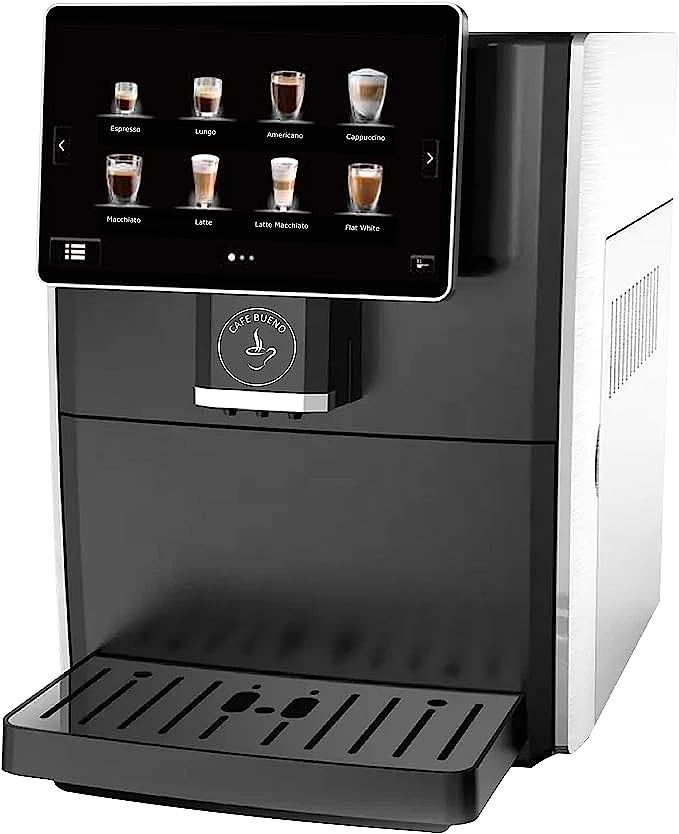
There’s a quiet drama that unfolds in your kitchen each morning. It’s a performance that begins with a percussive rattle of beans and ends with a velvety, aromatic liquid in your favorite cup. We often treat this ritual as a simple transaction: push a button, receive coffee. But what if you were to see your super-automatic coffee machine not as a mere appliance, but as a deeply sophisticated orchestra, and its touchscreen, like the one on the Cafe Bueno CB-3000, not as a control panel, but as a conductor’s baton? The power to transform a good cup into an exceptional one lies not in the machine alone, but in understanding the music it plays. This is a journey into the science of that symphony, a look behind the curtain to reveal how fundamental principles of chemistry and physics are harnessed to create your daily masterpiece. And the best part? Understanding these principles empowers you to command any advanced coffee machine, turning it from a black box into a transparent instrument for your personal taste. Whether you own a Cafe Bueno, a Jura, or a De’Longhi, the science remains the same.
The Overture: Freshness and the Tyranny of Time
Our symphony begins, as all great coffee does, with the bean. A roasted coffee bean is a miniature treasure chest, packed with hundreds of volatile aromatic compounds. But this treasure is incredibly fleeting. The moment you grind coffee, you exponentially increase its surface area, exposing this delicate essence to its sworn enemy: oxygen. This process, oxidation, is the thief of flavor. Scientific literature, such as that found in Scott Rao’s “The Coffee Roaster’s Companion,” suggests that within just 15 minutes of grinding, coffee can lose over 60% of its vibrant aroma. This isn’t coffee snobbery; it’s chemistry.
This is why the most critical feature of any high-quality, bean-to-cup machine is its built-in grinder. A machine like the CB-3000, which grinds beans just seconds before brewing, is fundamentally designed to fight this battle against time, ensuring the soul of the coffee—its aroma—actually makes it into your cup. But freshness is only half the story. The size of the grind is equally crucial. Think of water flowing through a column of pebbles versus a column of fine sand. The water rushes through the pebbles but slows down and interacts intimately with the sand. It’s the same with coffee. An espresso requires a very fine grind (typically 200-400 microns) to create enough resistance for high-pressure water to extract flavor in a short time. Too coarse, and you get “channeling”—the water finds easy paths through, under-extracting the coffee and leading to a sour, weak shot. The ability to adjust grind size, from “very fine to coarse” as the CB-3000 allows, is your first and most powerful tool for controlling flavor. No matter the brand or model, mastering the grind is the first step from coffee drinker to coffee composer.
The Crescendo: The High-Pressure Drama of Extraction
With the beans perfectly ground, our score is written. Now, the orchestra’s most dramatic section takes the stage—the high-pressure performance of extraction. This is where powder becomes poetry. For espresso, this process is a carefully balanced act governed by a golden trio of variables: temperature, pressure, and the resulting contact time.
Temperature is the catalyst. It’s not just about being “hot.” The Specialty Coffee Association (SCA) has long identified the ideal temperature range for extraction as being between 195-205°F (90-96°C). In this window, you achieve a balanced extraction of desirable acids, sugars, and oils. Too cool, and your coffee will taste sour and underdeveloped. Too hot, and you risk scalding the grounds, unleashing bitter, unpleasant flavors.
Pressure is the force. The benchmark of “9 bars”—roughly nine times the atmospheric pressure at sea level—is the standard for a reason. It’s the force needed to emulsify the coffee’s oils with water, creating the rich body and the signature reddish-brown crema that sits atop a well-pulled shot. Many modern machines also employ a gentle, low-pressure “pre-infusion” at the start, which wets the coffee puck to prevent channeling and promote a more even extraction.
Together, these variables determine the extraction yield—how much of the coffee’s soluble mass ends up in your cup. The SCA’s “Gold Cup Standard” targets a yield of 18-22%. Fall short, and it’s sour (under-extracted); go over, and it’s bitter (over-extracted). When a machine like the Cafe Bueno CB-3000 offers programmability over “temperature” and the “amount of water used,” it is handing you direct control over this delicate dance. By adjusting the water volume, you are directly influencing the contact time between water and coffee, effectively telling the machine how much flavor to pull. This is the heart of customization and your key to dialing in the perfect taste.
The Harmony: The Delicate Alchemy of Milk Frothing
But for many, the intense solo of an espresso is just the beginning. The symphony isn’t complete without the harmonious integration of the string section—the velvety, sweet alchemy of steamed milk. Transforming cold, liquid milk into the stable, silky microfoam required for a latte or cappuccino is a fascinating piece of science.
It’s all about protein and fat. When you inject steam into milk, two things happen. The heat begins to denature the milk proteins (primarily casein and whey), causing them to unravel. At the same time, the steam injects air. These unraveled proteins are fantastic at forming a stable network around the newly introduced air bubbles, creating foam. The goal for many specialty drinks is “microfoam,” where the bubbles are so small they are invisible, resulting in a texture like wet paint. The fat content in milk, while slightly destabilizing to the foam structure, is crucial for richness and mouthfeel. This is why whole milk often produces the most luxurious-tasting, if not the most voluminous, foam. Automated systems, like the one in the CB-3000 that works with all milk types, aim to control this process precisely, delivering consistent texture at the press of a button. Understanding this science helps you troubleshoot when your oat milk isn’t cooperating—it may simply have a different protein and fat structure to work with.
Coda: The Unseen Guardian of Flavor – The Ritual of Cleanliness
A symphony can be ruined by a single out-of-tune instrument. In coffee, that disruptive element is often residue from past performances. Over time, coffee oils build up inside the brewing mechanism. While flavorful when fresh, these oils quickly turn rancid, imparting stale, off-tastes to every subsequent cup. Similarly, mineral deposits from water (limescale) can build up in the heating system, affecting temperature stability and water flow.
Recognizing this, sophisticated machines are equipped with self-cleaning options. The four cleaning cycles on the CB-3000—from a milk system rinse to a deep brewer descale—are not just conveniences; they are essential maintenance rituals. An automated cleaning cycle is the unsung hero that ensures the purity of every brew, safeguarding both the flavor of your coffee and the longevity of your machine. A clean machine is the foundation upon which every great coffee symphony is built.
Encore: You Are the Composer
The journey from a simple button-pusher to a home barista is one of discovery. By understanding the fundamental principles—the rapid decay of aroma after grinding, the delicate balance of extraction variables, the alchemy of milk texturing, and the critical importance of cleanliness—you are no longer just a consumer of coffee. You are its composer. Your super-automatic machine is not a magical box, but a powerful, precise instrument waiting for your direction. So, experiment. Adjust the grind one notch finer. Nudge the temperature up a degree. You are the conductor, and a world of flavor awaits your command.
