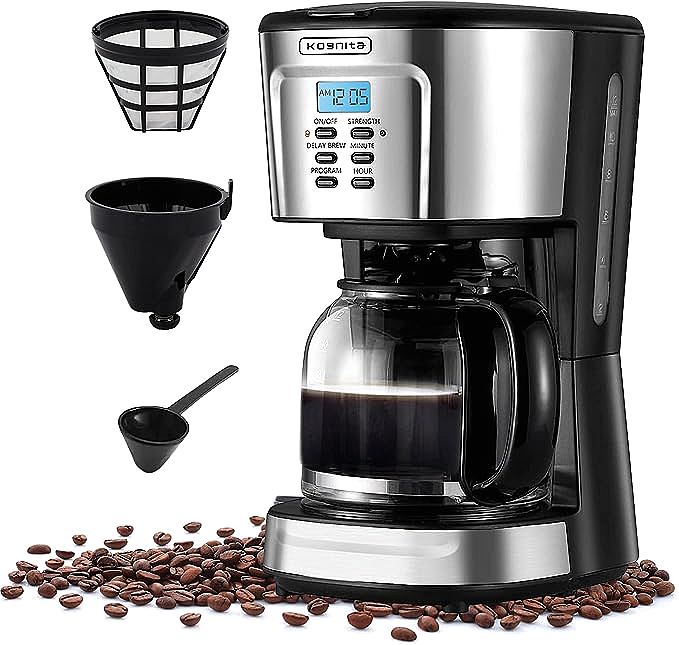

For many, the daily coffee ritual is a simple comfort, a sensory signal that the day has truly begun. We push a button, and within minutes, a fragrant, life-giving elixir fills a carafe. But beneath this veneer of simplicity lies a meticulously controlled scientific process. The countertop drip coffee maker is not merely an appliance; it’s a desktop laboratory, harnessing fundamental principles of physics and chemistry to perform a delicate extraction. What separates a vibrant, flavorful cup from a dull, bitter one isn’t luck—it’s engineering.
Using a representative modern appliance, the Kognita 12-Cup Programmable Coffee Maker, as our transparent case study, we will pull back the stainless-steel curtain. We will deconstruct its operation not by its features, but by the scientific laws it obeys. This is an exploration of the thermodynamics, fluid dynamics, and material science that converge to engineer the perfect cup.

Thermodynamics: The Engine of Extraction
The single most critical variable in brewing coffee is water temperature. This is the first commandment of coffee science. The Specialty Coffee Association (SCA) has defined a “Gold Cup Standard,” specifying that the ideal water temperature for optimal extraction lies within a narrow window of 195°F to 205°F (90°C to 96°C). Below this range, the water is too chemically timid, failing to dissolve the desirable flavor compounds, resulting in a sour, underdeveloped brew. Above it, the water becomes too aggressive, violently stripping out bitter, astringent elements and creating a harsh, burnt taste.
Our case-study machine, like many quality brewers, is engineered to operate within this precise thermal window. The engine driving this is its 900-watt heating element. In thermodynamics, power (watts) is the rate of energy transfer. A 900-watt system is not about brute force, but about speed and control. It must rapidly bring the reservoir of room-temperature water up to the target brewing temperature. Why is speed so critical? A slow heating process would mean the first drops of water hitting the coffee grounds would be too cool, beginning an uneven and flawed extraction. By achieving and maintaining the target temperature quickly, the machine ensures that the entire coffee bed is treated to a consistent and optimal thermal environment from start to finish, laying the foundation for a balanced extraction.
But the thermodynamic story doesn’t end when the brewing is done. The warming plate is another calculated balancing act. The Kognita keeps the carafe at 175°-185°F. This isn’t an arbitrary temperature. It’s hot enough to maintain a pleasant drinking temperature but low enough to slow the degradation of the delicate aromatic compounds that give coffee its character. Too hot, and you’d effectively be “cooking” the coffee, rapidly destroying its flavor. This feature is a direct application of thermodynamics to prolong the life of the finished brew.
But achieving the perfect temperature is only half the battle. Once this precisely heated water is ready, it faces its next great challenge: how to deliver itself to the coffee grounds without creating chaos. This is where we move from the world of heat to the equally critical domain of fluid dynamics.

Fluid Dynamics: The Art of Uniform Saturation
Imagine watering a plant with a single, powerful jet of water. It would drill a hole in the soil, over-saturating the center while leaving the edges dry. This exact phenomenon, known in the coffee world as “channeling,” is the arch-nemesis of a good brew. Water will always follow the path of least resistance. If it can create a single channel through the coffee grounds, it will bypass large portions of the coffee bed, leading to a disastrously uneven extraction—a brew that is simultaneously sour (from the under-extracted parts) and bitter (from the over-extracted channel).
To combat this, engineers have moved beyond the primitive single-drip spout. The Kognita employs a 6-hole outlet sprayer, which acts like a showerhead. This design is a straightforward application of fluid dynamic principles to widen the area of impact. By distributing the water over a larger surface, it promotes a more uniform saturation of the entire coffee bed. This even “wetting” ensures that all coffee particles are given an equal opportunity to release their soluble compounds, which is the very definition of a balanced extraction.
Advanced brewers offer another layer of control: brew strength. How can a machine make coffee “stronger” without making the water hotter? The answer lies in manipulating time, a key variable in any extraction equation. It is likely that selecting a “bold” setting engages a “pulse brewing” algorithm. Instead of a continuous stream, the machine’s controller might release water in stages, pausing briefly in between. These pauses extend the total contact time between the water and the grounds. A longer contact time allows for a higher percentage of Total Dissolved Solids (TDS)—literally, more “coffee stuff”—to be extracted into the water, resulting in a richer, more robust cup. It’s a clever piece of programming that gives the user direct, albeit simplified, control over the extraction yield.
With temperature and water delivery optimized, our system is performing flawlessly. Yet, all this precision could be instantly undone if the very vessel containing the process tainted the result. The final piece of our engineering puzzle isn’t about what the machine does, but what it is. We now turn to the unsung hero of pure flavor: material science.
Material Science: The Unsung Hero of Pure Flavor
The materials chosen for a coffee maker are not aesthetic afterthoughts; they are fundamental to preserving the integrity of the final product. The use of stainless steel in the Kognita’s housing and internal components is a deliberate choice rooted in materials science. Stainless steel’s magic lies in a phenomenon called passivation. The chromium within the alloy reacts with oxygen to form a microscopic, inert, and incredibly stable layer of chromium oxide on its surface. This passive layer acts as a shield, preventing the underlying metal from reacting with the acidic coffee environment. This is why it doesn’t rust and, crucially, why it doesn’t impart any unwanted metallic taste. It ensures the only flavors in your cup are the ones from the bean.
The final component in the chain is the filter. This machine includes a reusable mesh filter. While environmentally friendly, its impact on flavor is also significant. Paper filters are excellent at trapping very fine particles, or “fines,” but in doing so, they also absorb a large portion of the coffee’s natural oils. These oils, or lipids, are responsible for a huge part of the coffee’s aroma and contribute to a richer, heavier body or “mouthfeel.” A reusable mesh filter, with its larger pores, allows these oils to pass through into the carafe. This results in a cup that is often more aromatic and has a more viscous, full-bodied character—a clear trade-off between the “cleanliness” of a paper-filtered cup and the “richness” of one from a mesh filter.

Conclusion: The Engineered Elixir
The journey from roasted bean to brewed cup, when viewed through a scientific lens, is a testament to controlled engineering. A modern drip coffee maker is a system designed to meticulously manage variables of temperature, time, fluid dynamics, and material purity. It automates a process that a professional barista struggles to perfect by hand.
By understanding the “why” behind the design—why 200°F is a target, why a showerhead delivery matters, why stainless steel is superior to reactive metals—we are elevated from passive users to informed brewers. This knowledge empowers us to work in harmony with the machine, making smarter choices about our coffee beans, grind size, and water quality. Science has provided the tool; this understanding provides the mastery to unlock its full potential, transforming a simple morning ritual into a consistently delightful and deeply understandable experience.
