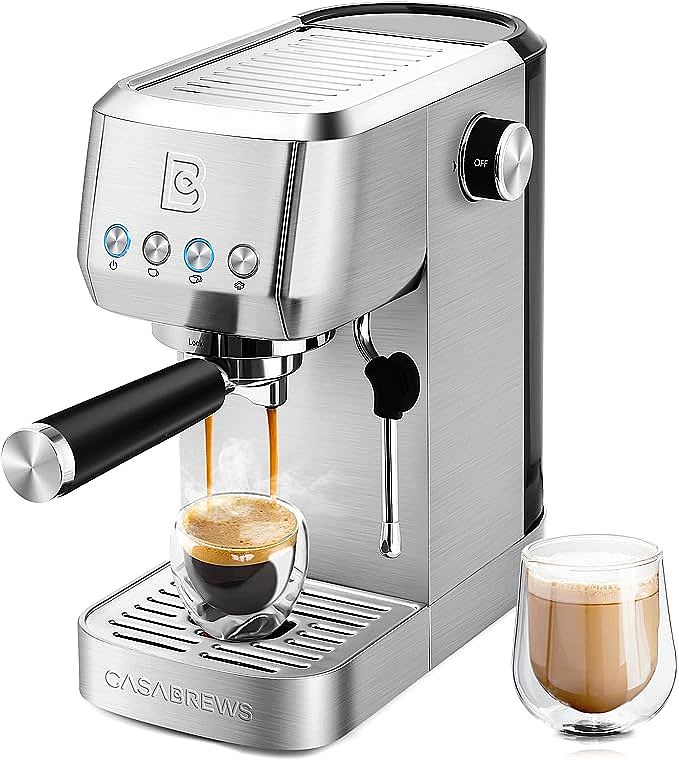

The ritual is unmistakable. A satisfying click as the portafilter locks into place, a low hum that builds into a steady, reassuring pump, and finally, the quiet hiss as a stream of liquid umber cascades into a pre-warmed cup. This daily ceremony, enacted in kitchens worldwide, is more than a morning habit. It’s the modern echo of a 150-year-old obsession that began in the bustling, industrial heart of 19th-century Europe: the quest to make a perfect cup of coffee, faster.
Your kitchen counter espresso machine, whether it’s a sleek device like the CASABREWS 3700 ESSENTIAL or another of its kind, is not merely an appliance. It is a time machine and a laboratory. It’s the culmination of a relentless journey into the physics of pressure and the deep chemistry of flavor, ingeniously packaged to fit next to your toaster. To truly appreciate the shot in your hand, we must travel back. Back to a time of steam and steel, before the world knew the pleasure of a rich, velvety crema.

The Ghost of Steam: Why Pressure Became King
In 1884, a Turin-based inventor named Angelo Moriondo patented a magnificent, steam-driven “instantaneous” coffee beverage apparatus. His goal was singular: to serve coffee to the impatient customers of his hotel and café at lightning speed. Moriondo’s machine used the brute force of steam and boiling water to blast its way through a bed of coffee. It was a marvel of industrial efficiency, but the coffee it produced was often brutally over-extracted, scorched, and bore little resemblance to the nuanced beverage we cherish today. The key element was scalding steam, not refined pressure.
The true revolution, the moment that defines modern espresso, arrived in a post-war Milanese café in 1947. It was there that Achille Gaggia, frustrated with the scorched taste of steam-driven coffee, introduced a radical invention: the spring-piston lever machine. By using a hand-operated lever to compress a spring, which then drove a piston to force hot, but not boiling, water through the coffee grounds, Gaggia achieved something extraordinary. He had generated a controlled, high-pressure environment. And from this pressure, a new substance was born: crema. This iconic, hazelnut-colored layer of tiny, stable bubbles wasn’t just for show; it was a complex emulsion of coffee oils and gases, carrying the most volatile, aromatic compounds.
Gaggia’s invention solved the problem of scorched coffee, but it introduced a new, powerful variable into the equation: pressure. But how much is enough? This brings us to one of the most misunderstood numbers printed on the box of almost every modern espresso machine…

The Pressure Paradox: Deconstructing “20 Bars”
Your CASABREWS 3700 box, like many others, proudly proclaims “20 Bars” of pressure. It’s a big number that sounds impressive, suggesting immense power. But here lies the paradox: the gold standard for a perfect espresso extraction, as recognized by authorities like the Italian National Espresso Institute (INEI), is a steady, unwavering 9 bars of pressure delivered directly to the puck of coffee grounds.
Think of it like this: your car’s speedometer might go up to 150 mph, but for optimal control, efficiency, and performance in most conditions, you drive at 65 mph. The 20-bar rating on your machine’s pump is its maximum potential output, its “top speed.” This overhead capacity is crucial because it ensures the pump can consistently deliver a stable 9 bars, even when faced with the significant resistance of a finely ground, well-tamped puck of coffee.
Entry-level machines like the 3700 Essential employ a clever piece of engineering to help beginners achieve this pressure without extensive training: the pressurized (or dual-walled) portafilter basket. Unlike a professional single-walled basket, which is full of tiny holes, a pressurized basket has only one, minuscule exit hole. This single pinhole creates a traffic jam for the water, artificially building up pressure regardless of how coarse your grind is or how well you’ve tamped. It’s a forgiving system that guarantees a foam that looks like crema. However, this “pseudo-crema” is often just aerated coffee, lacking the silky texture and rich flavor of a true, 9-bar extraction. It’s a fantastic training wheel, but to truly explore your machine’s potential, you’ll eventually want to take it off.
So, we have our 9 bars of controlled force, ready to unlock the secrets within the coffee bean. But this force is merely the messenger. The message itself—the very language that speaks to the coffee grounds and persuades them to release their flavor—is written in the invisible ink of temperature.
A Symphony of Heat: The Thermoblock’s Hasty Dance
If pressure gives espresso its body, temperature orchestrates its complex flavor symphony. The Specialty Coffee Association (SCA) specifies an ideal brewing water temperature between 92°C and 96°C (198°F-204°F). A deviation of only a few degrees can be disastrous. Too cold, and the extraction is weak, sour, and grassy as acids are dissolved but not the deeper sugars and oils. Too hot, and you scorch the delicate compounds, resulting in a bitter, hollow taste.
High-end machines use heavy, insulated boilers to hold a large volume of water at a perfectly stable temperature. To achieve this in a compact, affordable, and fast-heating package, the CASABREWS 3700 uses a Thermoblock heating system. Imagine a metal block with a long, coiled tube running through it. As you brew, water is pumped through this heated maze, flash-heating on demand.
The advantage is speed; the machine is ready to brew in under a minute. The compromise is thermal stability. The small mass of the thermoblock and the constantly moving water mean the temperature can fluctuate during the 25-30 second extraction. This isn’t a flaw; it’s an engineering trade-off. It’s also the source of much of the “inconsistency” new users experience. Understanding this “hasty dance” of the thermoblock is key. It explains why pre-heating the entire system by running a blank shot is not just a suggestion, but a scientific necessity. It’s about giving the thermoblock a running start to stabilize its temperature before it meets your precious coffee grounds.

Conclusion: Your Diploma from the Kitchen Laboratory
By understanding the interplay of pressure and temperature, you’ve already graduated from being a simple user to an informed operator. You now know that the “20 Bars” on the box is a marketing spec, and the true magic happens at 9. You understand that the forgiving pressurized basket is a great starting point, but true mastery lies beyond it. And you recognize that your machine’s quick heat-up time comes with a temperature dance that you can learn to lead.
A machine like the CASABREWS 3700 ESSENTIAL is a marvel of modern engineering, democratizing a century of coffee innovation. Its greatest value isn’t its ability to perfectly replicate a café’s $5,000 machine, but its role as an accessible, hands-on learning tool. It is your personal laboratory. Embrace its quirks as variables in your experiment. Taste your mistakes, celebrate your successes, and enjoy the deeply satisfying process of transforming steam, steel, science, and soul into the perfect shot of espresso.
