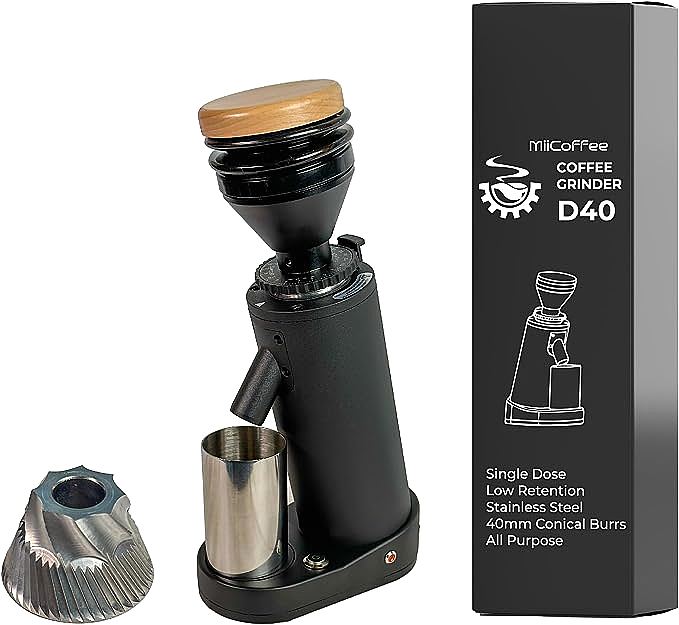

The journey to a transcendent cup of coffee is often perceived as a ritual of water, heat, and pressure. But the most profound transformation, the very moment a bean’s soul is unlocked, occurs in a fleeting, violent, and precise event: the grind. It is here, in the seconds between solid and particulate, that a coffee’s potential is defined. To understand the grind is to understand the heart of coffee itself. This is not a review, but rather a dissection. Using the MiiCoffee D40+ Single Dose Coffee Grinder as our specimen, we will explore the intricate science and deliberate philosophy that underpin the modern pursuit of the perfect grind at home.

The Heart of Precision: Deconstructing the 40mm Conical Burrs
At the core of any grinder lies its engine of transformation: the burrs. The D40+ is equipped with a set of 40mm stainless steel conical burrs. To the uninitiated, this might sound like just another line on a spec sheet, but to an engineer or a seasoned barista, it speaks volumes about the grinder’s intended purpose and performance profile.
Imagine the burrs not as blades that chop, but as a meticulously engineered mill. A cone-shaped inner burr rotates within a stationary, ring-shaped outer burr. As beans are drawn into the progressively narrowing gap, they are subjected to a complex combination of fracturing and shearing forces. This conical geometry is significant. Unlike flat burrs, which often require higher rotational speeds to be effective, conical burrs can operate more slowly. This generally translates to less heat generation—a critical factor, as excessive heat can prematurely volatilize the delicate aromatic compounds that define a coffee’s character, essentially “cooking” them before they even meet water.
But what about the size, 40mm? In the world of grinders, where enthusiasts often chase larger and larger burr sets, a 40mm conical burr set represents a carefully considered balance. It’s large enough to provide efficient grinding for home use without the significant heat and power demands of a massive commercial set. The crucial point, however, is not size alone, but the quality of the particle distribution it produces.
This leads to a frequent debate in the coffee community: conical versus flat burrs. High-end flat burrs are often lauded for producing a unimodal particle distribution—a majority of grounds clustered tightly around a single target size, which often leads to high-clarity, tea-like extractions. Conical burrs, by their nature, tend to produce a more bimodal distribution, featuring a primary peak of a target size along with a smaller, secondary cluster of very fine particles (“fines”). While this might sound inferior, for espresso, it can be a feature, not a bug. These fines can increase the resistance of the coffee puck, helping to build pressure, and are often credited with contributing to a richer, more syrupy body and a thicker crema. Therefore, to dismiss the D40+’s burrs as merely “entry-level” is to miss the point. They are not an inferior choice, but a different choice, one that is arguably well-suited to its primary mission: producing rich, balanced espresso in a home setting.

The Freshness Doctrine: Single Dosing and the War on Retention
Even the most precisely engineered burrs are rendered useless if the coffee they grind is not at its aromatic peak. Roasted coffee is a volatile product. From the moment it leaves the roaster, it fights a losing battle against its sworn enemy: oxygen. This process of oxidation accelerates exponentially once the bean’s protective shell is shattered. Ground coffee can lose a significant portion of its vibrancy within minutes.
This is the philosophical battleground where the MiiCoffee D40+ plants its flag. It is a “single dose” grinder, a design philosophy that champions freshness above all else. Instead of a large hopper storing beans for days, exposing them to air and light, the user weighs out the precise amount needed for a single brew. This “grind-on-demand” approach ensures every cup is made from grounds that are mere seconds old.
However, single dosing introduces a critical engineering challenge: grind retention. “Retention” refers to the amount of ground coffee left trapped inside the grinder after a cycle. To properly discuss this, we must distinguish between two types. Total retention is all the coffee stuck inside the machine. Exchange retention is the portion of old, stale grounds that exit the grinder with the new dose you are grinding. For a single doser, minimizing exchange retention is the holy grail.
The D40+ tackles this with a multi-pronged strategy. Its aluminum body is tilted forward, using gravity to help grounds exit more completely. But its most active weapon is the “blow-out funnel,” or bellow. Some critics might view this manual air pump as a crutch for a less-than-perfect design. This perspective is understandable, but it overlooks the economic and engineering realities of this price point. Achieving near-zero retention through purely passive design (like the vertical pathways of the far more expensive Niche Zero) is a monumental challenge. The D40+’s active system is a pragmatic and highly effective solution. A few firm presses on the bellow create a jet of air that purges the grind chamber, resulting in an exchange retention often measured at less than 0.1 grams. The user’s small effort is rewarded with the ultimate prize: flavor purity.
The Art of Control: Navigating the Nuances of Grind Adjustment
Achieving near-zero exchange retention ensures purity, but purity without precision is chaos. To truly unlock a bean’s potential, a barista needs control—the ability to make minute adjustments to the grind size to “dial in” the perfect extraction. This is where the grinder’s adjustment mechanism enters the stage, and where the D40+ presents a fascinating case study in specification versus reality.
The grinder has been variously described as having 95 steps, 80 soft clicks, or being stepless. Our research indicates the truth is a nuanced combination of all three. The adjustment collar features a dial with numerous markings (around 95). As you rotate it, you can feel approximately 80 distinct, but soft, detents or “clicks.” However, critically, the mechanism allows the user to set the collar between these clicks. This makes it, in practice, a functionally stepless grinder. This level of granular control is a massive advantage for espresso, where a tiny shift in grind size can dramatically alter shot time and taste. It empowers the user to move beyond coarse, clumsy adjustments and enter the world of scientific, iterative brewing.
Powering this entire process is a 150-watt motor. While wattage indicates power consumption, the more crucial metric for grinding is torque—the rotational force applied to the burrs. The ability of the D40+ to grind light-roasted, high-density beans without stalling, as reported in multiple tests, suggests its motor and gear system are engineered to provide sufficient torque, a vital capability for enthusiasts exploring the full spectrum of specialty coffee.
Conclusion: The Modern Home Barista’s Instrument
The MiiCoffee D40+ is more than an appliance; it is an instrument built around a clear and modern philosophy of home coffee brewing. It prioritizes the uncompromising pursuit of freshness through a single-dose workflow. It delivers the precision needed for serious espresso through its functionally stepless adjustment. And it achieves this with a pragmatic and effective low-retention system, all housed within a solid, compact form.
To choose a grinder is not to find the “best” one in a vacuum, but to select the tool whose design philosophy aligns with your own. The D40+ is not trying to be a do-it-all commercial workhorse. It is, instead, a focused and compelling instrument for the discerning home barista who understands that the alchemy of a truly great cup of coffee begins not with the water, but with the profound and beautiful destruction of a single, perfect bean. Understanding the science locked within that instrument is the first, and most crucial, step on that journey.
