
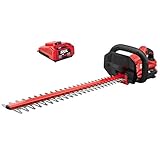
If you’re shopping for cordless tools, you will inevitably ask this question, just like a user on the SKIL HT4221-10’s product page: “Does this battery pack fit other Skil 40V tools?”
The answer (in that case, yes) leads to a much more important, and frustrating, follow-up: “Will it fit my Ryobi 40V tools?”
The answer is a hard no.
This is not an accident. It’s not a design flaw or a lack of industry standardization. It is a deliberate, highly effective business strategy that the entire power tool industry is built on.
Welcome to the “Battery Ecosystem” trap.

The “Printer and Ink Cartridge” Model of Power Tools
Years ago, printer companies discovered a brilliant business model: sell the printer itself at a very low price (sometimes even at a loss), and make all the profit on the expensive, proprietary ink cartridges that only fit that printer.
The power tool industry runs on the exact same playbook.
* The Tool (Trimmer, Drill) = The Printer. It’s the “cheap” part of the equation.
* The Battery = The Ink Cartridge. This is the high-margin consumable. It’s where the real profit is.
When you buy a “Hedge Trimmer Kit” (like the SKIL HT4221-10, which includes a 2.5Ah battery), you are not just buying a hedge trimmer. You are buying into the SKIL 40V ecosystem.
Understanding “Brand Lock-In” (The “Ecosystem” Trap)
The goal is to get you “locked in.” A user named Dave, in a review for the SKIL trimmer, explained this perfectly:
“If you have other battery powered tools from another company, stick with them so you can share batteries. But, consider these if you’re not locked into another ecosystem.”
He is describing Brand Lock-In. The psychology is simple:
1. You buy the SKIL trimmer kit. You now own one 40V battery and one charger.
2. Six months later, you need a leaf blower.
3. Even if a competing EGO leaf blower is slightly better, you will almost certainly buy the SKIL “bare tool” (the tool without a battery), because it’s much cheaper and works with the battery you already own.
4. Now you own two tools and one battery.
5. A year later, you buy another battery.
6. Congratulations. You are now “locked in.”
The “switching cost” has become too high. To switch to EGO, you would have to sell all your SKIL tools and batteries at a loss and start your collection from scratch. You’re a SKIL customer for life, not necessarily because they’re the best, but because they were your first.
The “Safety” Argument vs. The Business Reality
But isn’t this also about safety? If you ask a manufacturer why their 40V battery doesn’t work in another brand’s 40V tool, they will give you a very good, and partially true, answer: Safety and Performance.
Modern lithium-ion batteries are not just “dumb” cans of power. They contain a sophisticated computer called a Battery Management System (BMS). This BMS is in constant digital communication with the tool.
* It monitors cell temperature to prevent fires (like we discussed with SKIL’s PWR CORE).
* It manages power output to deliver peak torque (like we discussed with brushless motors).
* It prevents the battery from over-discharging.
This communication is a proprietary “digital handshake.” If the SKIL tool doesn’t detect the “handshake” from a genuine SKIL BMS, it will refuse to turn on. This is, genuinely, a feature to prevent you from using a cheap, poorly made battery that could damage the tool or catch fire.
It also just so happens to be the perfect, impenetrable “lock” for their “walled garden” ecosystem. It’s a safety feature that doubles as a brilliant business strategy. (Note: This is why you should never use those third-party battery adapters you see online; they bypass these critical safety handshakes).

How to Choose Your First (and Last) Battery Ecosystem
You cannot avoid the trap. You can only choose your trap wisely.
1. Don’t buy one tool. Buy a system. Before you buy that first trimmer, go to the brand’s website. Do they also make a mower, a blower, a chainsaw, and a drill in that same voltage (e.g., 40V) that you might need one day?
2. Assess the “Ink” (The Battery). Is the battery technology good? Does it have thermal management (like SKIL’s PWR CORE)? Is the fast charger “smart”?
3. Commit. Once you’re in, you’re in.
Your first battery-powered tool purchase is one of the most important buying decisions you’ll make as a homeowner. Choose your “ecosystem” carefully, because you’ll likely be living in it for a very long time.
