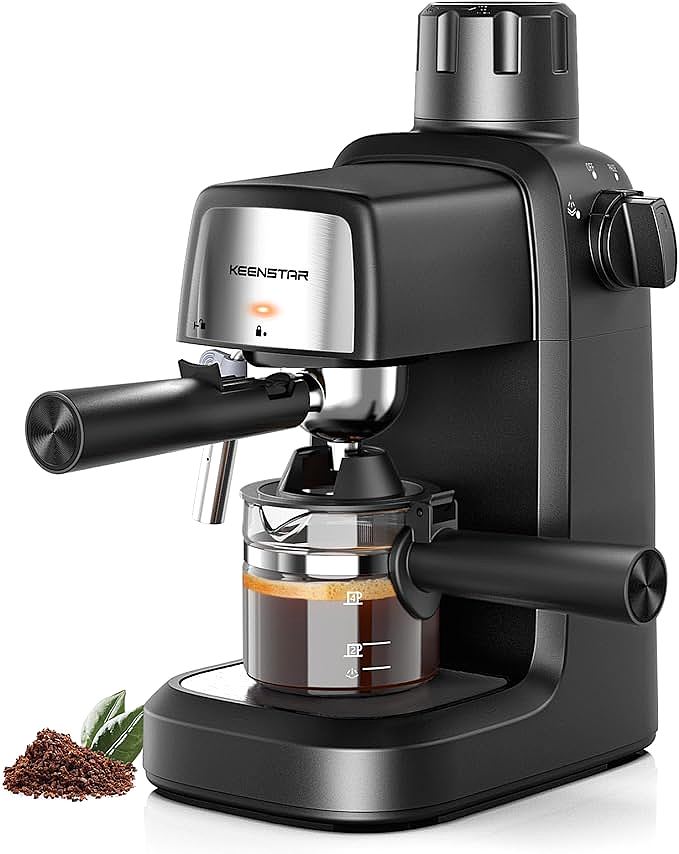
In the genealogy of coffee technology, the modern pump-driven espresso machine is a relatively recent ancestor. Before the high-pressure electric pump revolutionized the café in the mid-20th century, coffee was brewed using the elemental power of Steam. The KEENSTAR BCM2201, with its 3.5 bar pressure rating, is a direct descendant of this lineage. It is, in essence, an electric steam engine dedicated to the extraction of alkaloids and oils from the coffee bean.
To understand this machine is not to compare it directly to a $5,000 commercial unit, but to appreciate it as a distinct thermodynamic system. It operates on principles closer to a stovetop Moka pot than a La Marzocco. This article dissects the physics of steam propulsion, the thermodynamics of high-temperature extraction, and the unique sensory profile generated by this method. It is a study of how heat creates motion, and how motion creates coffee.
The Physics of Steam Propulsion: Generation of Force
The core mechanism of the KEENSTAR BCM2201 is a sealed Pressure Vessel (the water tank). Unlike pump machines that use a piston or rotary vane to mechanically force water, this machine uses Phase Change.
1. Heating: The 800W element heats the water in the sealed chamber.
2. Expansion: As water approaches boiling (100^{\circ}C), it transitions to steam. Steam occupies 1,600 times the volume of liquid water. Since the vessel is sealed, this expansion is constrained, causing pressure to build.
3. Displacement: The pressure builds until it exceeds the resistance of the coffee puck (and the internal check valves). This pressure—approximately 3.5 Bar (50 PSI)—pushes the boiling water up a siphon tube and down through the coffee grounds.
This is a Passive Pressure System. The pressure is not constant; it ramps up as the water boils and fluctuates based on the temperature. It is a chaotic, organic process compared to the linear, controlled force of a mechanical pump. Understanding this helps users realize why the extraction flow might pulse or vary—it is the heartbeat of the boiling water inside.

Thermodynamics of Extraction: The Temperature Variable
In standard espresso theory, the ideal brewing temperature is between 90^{\circ}C and 96^{\circ}C. However, physics dictates that for water to generate 3.5 bar of steam pressure, it must be heated well above 100^{\circ}C (superheated).
This presents a thermodynamic paradox for steam machines: To get the pressure, you must overheat the water.
When the water hits the coffee grounds in the KEENSTAR, it is often boiling or near-boiling.
* The Result: High-temperature extraction tends to solubilize more bitter compounds (tannins, pyrolytic breakdown products) and can “scorch” delicate aromatics.
* The Flavor Profile: Coffee from a steam machine is typically robust, dark, and intense. It lacks the nuanced acidity of pump espresso but offers a heavy, strong punch that cuts through milk effectively.
This thermal reality dictates the coffee choice. Darker roasts, which are already chemically simple and robust, tend to fare better in this high-heat environment than delicate light roasts. The machine is an engine for “Coffee Strong,” not “Coffee Subtle.”
3.5 Bar vs. 9 Bar: The Crema Distinction
The “Holy Grail” of espresso is Crema—the golden foam of emulsified oils and CO_2. True crema requires high pressure (typically 9 bar) to emulsify the insoluble oils and supersaturate the liquid with gas.
At 3.5 Bar, the pressure is insufficient to create a stable, micro-cellular emulsion.
* Foam vs. Crema: The KEENSTAR produces a layer on top of the shot, but it is often larger-bubbled foam created by the turbulence of steam escaping with the water, rather than the high-pressure emulsification of oils.
* Mouthfeel: The texture is lighter and less viscous than 9-bar espresso.
However, 3.5 bar is significantly higher than gravity (drip coffee). It forces water into the cellular structure of the bean more effectively than a drip machine, extracting more solids and creating a beverage that is physically denser and chemically more potent than standard coffee. It occupies a middle ground: Stronger than Drip, Lighter than Espresso.

Case Study: The Engineering of Simplicity
The KEENSTAR BCM2201 is designed for Mechanical Simplicity. It lacks the complex 3-way solenoid valves, thermoblocks, and vibratory pumps of expensive machines.
* The Boiler: A single aluminum or stainless vessel acts as reservoir, heater, and pump. This integration reduces failure points. There are no moving parts to wear out.
* The Portafilter: The basket design is often optimized for this lower pressure, using a specific hole pattern to offer resistance and create the spray that generates foam.
This simplicity translates to durability and ease of use, provided the user respects the physics. You cannot “backflush” this machine. You cannot control the temperature directly. You are the operator of a steam train; you load the fuel (water/coffee), set the throttle (knob), and let the thermodynamics take over.
Conclusion: Respecting the Steam
The KEENSTAR BCM2201 is a valid and historically significant approach to coffee making. It brings the physics of the Moka Pot to the countertop with the convenience of electric heating.
By understanding that it is a steam-driven device, users can adjust their expectations and techniques. It will not produce the syrupy shot of a $3000 machine, but it will produce a hot, strong, and energetic cup that serves as a perfect base for milk drinks. It is a triumph of basic physics over complex electronics, proving that heat and pressure, in their simplest forms, are all you need to extract the soul of the bean.
