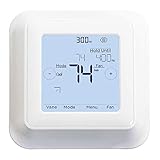
You have two smart devices in your living room. One is a Wi-Fi security camera, streaming flawless HD video to the cloud. The other is a smart thermostat, which seems to lose connection to its remote sensor every other day, causing your HVAC system to run erratically. They are ten feet apart. Why is one rock-solid and the other a constant source of frustration?
The answer lies hidden in the invisible language these devices speak. It’s not about the brand or the price tag; it’s about the underlying wireless communication protocol they use. In the world of smart homes, and particularly in mission-critical systems like HVAC, three dominant philosophies are at war: the ubiquity of Wi-Fi, the open collaboration of Zigbee, and the controlled perfection of proprietary systems like Mitsubishi’s RedLINK.
Understanding the difference isn’t just an academic exercise. It’s the key to building a smart home that is reliable, efficient, and doesn’t leave you troubleshooting in the middle of a heatwave.

The Battlefield: A Quick Intro to the Contenders
Before we dive deep, let’s quickly meet the players:
- Wi-Fi (IEEE 802.11): The protocol you know and love. It’s built for high-speed data transfer, perfect for streaming video and browsing the web. It’s everywhere, and connecting a new device is simple.
- Zigbee (IEEE 802.15.4): An open standard designed specifically for low-power, low-data-rate devices. It’s not for watching Netflix, but for sending small packets of information—like “temperature is 22°C” or “turn on the light.”
- RedLINK (Proprietary): A closed, proprietary system developed by Honeywell and used by partners like Mitsubishi Electric. It’s a specialized tool built from the ground up for one job: ultra-reliable HVAC control.
But beyond the names and logos, these protocols represent fundamentally different philosophies on how devices should talk to each other. Let’s start with the most critical question for any user: which one will actually work when you need it to?
Dimension 1: Reliability – Surviving the Digital Noise
The single most important factor for an HVAC control system is that it just works. Here, the protocols diverge dramatically.
The 2.4GHz Traffic Jam vs. The Quiet Country Road (Sub-GHz)
Both Wi-Fi and Zigbee primarily operate in the 2.4GHz frequency band. Think of this band as a massive, public superhighway. It’s incredibly busy. Your Wi-Fi router, your neighbor’s router, your Bluetooth headphones, your microwave oven—they’re all shouting at each other in this same crowded space. This “noise” can lead to interference, dropped packets, and lost connections.
Proprietary systems like RedLINK often take a different approach. They operate in the “Sub-GHz” band, specifically around 900MHz in North America. This is like a private country road. There’s far less traffic, meaning a much cleaner signal. Furthermore, lower-frequency radio waves are physically better at penetrating walls and other obstacles. This is a huge advantage in a real-world home environment, directly translating to a more robust and longer-range connection between a thermostat and its sensors or indoor units.
Star vs. Mesh: A Lone Runner vs. a Relay Team
The second critical difference is network topology. Wi-Fi and (typically) RedLINK operate on a star network. Every device connects directly to a central hub (your router or the HVAC receiver). If a device is too far from the hub, it’s out of luck.
Zigbee, on the other hand, is built for mesh networking. Imagine a relay race. In a mesh network, mains-powered devices (like smart plugs or light bulbs) can act as repeaters. A signal from a distant sensor doesn’t have to make it all the way back to the hub in one go. It can “hop” from one device to another, extending the network’s range and creating multiple redundant paths. If one path is blocked, the network can automatically “heal” itself by routing the signal through another device. This makes mesh networks incredibly resilient in complex home layouts.
Dimension 2: Power – The Marathon Runners
Your Wi-Fi camera is plugged into the wall for a reason. Wi-Fi is a power-hungry protocol, designed for high bandwidth. A battery-powered Wi-Fi device would need its batteries replaced constantly.
This is where protocols based on IEEE 802.15.4, like Zigbee, shine. They are designed from the ground up for ultra-low power consumption. A Zigbee temperature sensor can run for years on a single coin-cell battery. This is achieved by allowing devices to spend most of their time in a deep sleep state, waking up for just milliseconds to transmit a tiny burst of data. This makes them perfect for “set-it-and-forget-it” devices scattered around a home. RedLINK operates on similar low-power principles, enabling its wireless thermostats to have long battery life.
Dimension 3: The Ecosystem – Walled Garden or Wild West?
So, we have reliable and power-efficient options. This begs the question: why would a major manufacturer like Mitsubishi Electric choose to develop its own proprietary system like RedLINK instead of just using an open standard like Zigbee? The answer has less to do with physics and more to do with strategy.
The Case for Proprietary Control (RedLINK)
This is the “walled garden” approach, similar to Apple’s. By controlling the hardware, software, and protocol, a manufacturer can guarantee a seamless and reliable user experience. They can optimize the protocol specifically for the demands of HVAC (e.g., using Frequency-Hopping Spread Spectrum (FHSS) for extreme noise immunity). They control the entire vertical stack, ensuring quality from end to end. The downside for the consumer, as noted in user reviews, is the “punishing ecosystem.” You’re locked in. Your Mitsubishi thermostat won’t talk to your Nest smoke detector. This control comes at the price of interoperability and often, a higher cost.
The Case for Open Collaboration (Zigbee)
This is the “wild west” or “Android” approach. As an open standard managed by the Connectivity Standards Alliance, hundreds of manufacturers can build Zigbee-compatible devices. This fosters competition, innovation, and lower prices. You can mix and match devices from different brands. The challenge? Interoperability isn’t always perfect. Different manufacturers might implement the standard in slightly different ways, sometimes leading to compatibility headaches. The quality control is decentralized, relying on certification programs.
The Verdict: Which Protocol for Which Job?
There is no single “best” protocol. The optimal choice depends entirely on the application.
| Dimension | Wi-Fi | Zigbee | RedLINK (Proprietary Sub-GHz) |
|---|---|---|---|
| Best For | High-data devices (Cameras, Speakers) | Low-power sensor networks | Mission-critical control (HVAC) |
| Reliability | Moderate (Susceptible to 2.4GHz interference) | High (Mesh network self-heals) | Very High (Quiet band, robust protocol) |
| Range | Moderate (Dependent on router) | High (Extendable via mesh) | Very High (Superior wall penetration) |
| Power Use | High | Very Low | Very Low |
| Interoperability | High (Universal Standard) | Moderate-High (Open Standard) | None (Closed Ecosystem) |
| Complexity | Low (Uses existing network) | Moderate (Requires a hub/coordinator) | Low (Plug-and-play within its ecosystem) |
The Future: Can ‘Matter’ Unite Them All?
The industry recognizes this fragmentation is a problem. The new Matter protocol, backed by Apple, Google, Amazon, and the Zigbee Alliance (now CSA), aims to be a unifying application layer. The idea is that devices running on different network protocols (like Wi-Fi and Thread, a new low-power mesh network) can all speak the same “language” at the top. This promises to bring the best of both worlds: the choice of an open ecosystem with the simplicity of a walled garden. Whether proprietary giants will fully embrace it for their core systems, however, remains to be seen.
For now, understanding the fundamental trade-offs between these wireless workhorses is the most powerful tool you have for building a truly smart—and truly reliable—home.
