
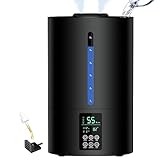
In the intricate physics of home comfort, stability is king. We insulate our walls to stabilize temperature, yet we often allow our indoor humidity to fluctuate wildly. A small humidifier runs dry at 3 AM, causing the Relative Humidity (RH) to plummet just as our respiratory systems are most vulnerable. This “humidity sawtooth” effect stresses our skin, wood furniture, and mucous membranes.
Achieving Humidity Homeostasis—a stable, unwavering moisture level—requires volume. It is a game of capacity. The Coolfiqu LP-2113 6L Humidifier addresses this fundamental thermodynamic challenge not with gimmicks, but with mass. By holding 6 liters (1.58 gallons) of water, it acts as a hydration anchor, capable of maintaining equilibrium for up to 60 hours without intervention.

The Physics of Atomization: Ultrasonic Mechanics
To understand this machine, one must understand cavitation. Like all ultrasonic units, the LP-2113 relies on a piezoelectric transducer—a ceramic disc vibrating at ultrasonic frequencies (typically 1.7 MHz).
These vibrations create microscopic vacuum bubbles in the water that implode violently, shattering the surface tension and ejecting droplets roughly 1-5 microns in size.
* Energy Efficiency: Unlike steam vaporizers that boil water (phase change), ultrasonic atomization is a mechanical process. It uses a fraction of the energy to put the same amount of water into the air.
* The “Cool” Factor: Because no heat is inherently required, the mist exits at room temperature, preserving the ambient thermal balance of your room during summer months.
Thermal Dynamics: Decoding “Warm Mist”
The LP-2113 distinguishes itself with a Dual-Temp feature. However, a common user misconception requires clarification: “Warm Mist” in an ultrasonic context is not steam.
In a steam vaporizer, water is boiled to 100°C (212°F). In the Coolfiqu LP-2113, the water is mechanically atomized first, and then passed over a PTC (Positive Temperature Coefficient) heating element.
* The Result: The mist exits at a lukewarm temperature (often around 40-50°C / 104-122°F), not boiling hot.
* The Benefit: This “tempered mist” serves a specific physical purpose. Warm water molecules have higher kinetic energy, allowing them to dissipate into the air faster than cool droplets. This increases the absorption rate (raising RH faster) and prevents the “wet floor” syndrome where heavy, cool droplets sink and condense on surfaces before evaporating. It is about saturation efficiency, not just heating the room.

The Volume Advantage: 6 Liters vs. Entropy
Why does a 6-liter tank matter? It comes down to the Rate of Decay. In a 500 sq. ft. room during winter, dry air infiltration acts as a constant drain on humidity. A small 2L tank fights a losing battle, often running empty halfway through the day.
With 6 liters, the LP-2113 provides a massive buffer.
1. Consistency: It allows the unit to run on lower settings for days, maintaining a steady 45% RH rather than spiking to 60% and dropping to 20%.
2. Sleep Architecture: The 60-hour potential runtime means zero disruptions. You are not waking up to a dry throat because the machine quit at 4 AM. This continuity is critical for maintaining the hydration of the cilia in your nasal passages, your body’s primary filtration defense.
Hygiene Engineering: The Cleaning Protocol
Large capacity comes with a responsibility: Water Management. Stagnant water is the enemy of hygiene. While the Top-Fill design makes refilling ergonomically superior (saving your back from lifting heavy tanks), it can encourage “topping off” without cleaning.
The Design Challenge:
User reports indicate the central mist column is non-detachable, creating a cleaning blind spot. To combat Biofilm (the slippery bacterial layer) in these hard-to-reach areas, mechanical scrubbing isn’t enough. You need chemistry.
* The Acid Soak Strategy: Since you cannot scrub the inside of the narrow column, you must rely on solubility. Weekly descaling with white vinegar (acetic acid) or citric acid is non-negotiable. The acid dissolves mineral scale (calcium/magnesium) where bacteria hide.
* Agitation: Fill the base with the solution, let it sit for 20 minutes to break down the biofilm, then vigorously swish to dislodge debris from the internal column.

Olfactory Architecture: Safe Aromatherapy
The integration of an essential oil tray is a nod to environmental psychology. However, material science dictates caution. Never add oils directly to the 6L tank. Oils are solvents that can degrade the ABS plastic of the tank and damage the piezoelectric plate. By using the dedicated tray, the device uses the airflow (Venturi effect) to pick up scent molecules without compromising the structural integrity of the water vessel.
Conclusion: The Stability Engine
The Coolfiqu LP-2113 is not designed for the casual user who wants a quick spritz of mist. It is an infrastructure device for those serious about atmospheric control. Its 6L capacity offers the luxury of continuity, effectively stabilizing the indoor microclimate against the drying effects of winter heating. While the “Warm Mist” may confuse those expecting steam, its thermodynamic role in efficient saturation is scientifically valid. By understanding its mechanics—and committing to a chemical cleaning protocol—this machine transforms from a simple appliance into a cornerstone of indoor health.
