For millions, it is the sound of the morning: a low hum, a gentle bubbling, and finally, a satisfying gurgle from the stovetop. The Moka pot, an icon of Italian design and domesticity, has been a kitchen staple for nearly a century. But beneath its familiar silhouette lies a remarkable feat of accessible thermodynamics. To dismiss it as a simple “percolator” is to overlook the elegant physics at play. Understanding the science of pressure, heat transfer, and material choice is the key not only to appreciating this ingenious device but to consistently brewing a superior cup of coffee. This is not just a coffee maker; it’s a desktop heat engine engineered for flavor.

A Tale of Two Pressures: Why Moka Is Not Espresso
A common misconception places Moka pot coffee under the umbrella of “espresso.” While both are concentrated, intensely flavored brews, the physics that create them are worlds apart. The difference lies in one fundamental variable: pressure. A commercial espresso machine employs a powerful pump to force hot water through a tightly packed puck of fine coffee grounds at a staggering 9 bars of pressure or more—over nine times the Earth’s atmosphere at sea level. This violent, high-speed extraction emulsifies the coffee’s oils and dissolves carbon dioxide, creating the thick, stable, and highly sought-after layer known as crema.
The Moka pot operates on a far more subtle principle. As water in the sealed lower chamber heats, it generates steam, building pressure to approximately 1.5 to 2 bars. This force is just enough to gently and steadily push hot water up through the coffee grounds. It’s not a blast; it’s a determined, even infusion. This lower-pressure process uses water at a higher temperature—water boiling under 1.5 bars of pressure reaches about 127°C (260°F)—which extracts a different profile of compounds. This explains the Moka pot’s characteristic heavy body and deep, caramelized notes, but also why it produces a lighter, frothier foam rather than a true, emulsified crema. It is its own magnificent class of coffee, born from ingenious simplicity, not immense power.

The Material Science of a Pure Brew: A Steel Story
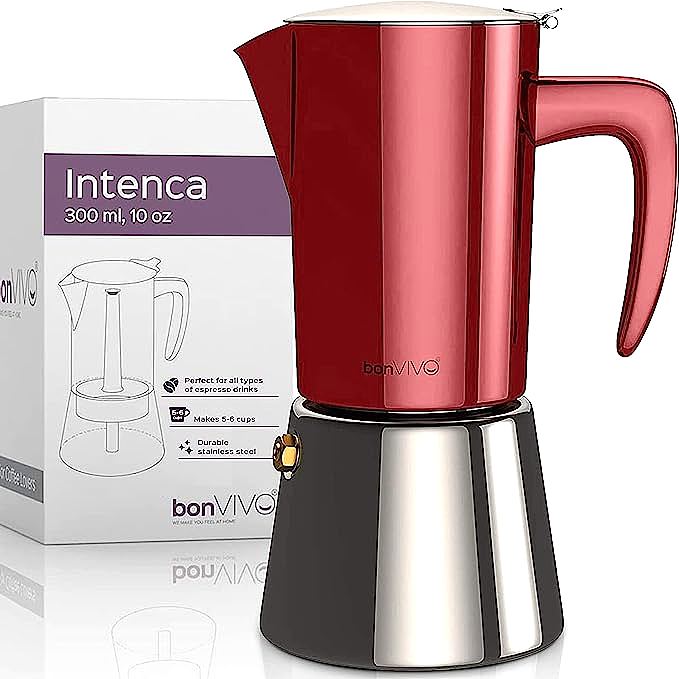
The pressure, however, is only half of the story. The very vessel that contains this reaction plays an equally critical role. The choice of metal isn’t merely aesthetic; it’s a fundamental decision in chemical engineering that directly impacts the final taste in your cup. While the original Moka pots were aluminum, modern iterations like the bonVIVO Intenca exemplify the shift to stainless steel, a choice rooted in superior performance.
First is flavor purity. High-quality stainless steel is chemically inert, meaning it won’t react with the acidic coffee. This ensures the flavor you taste is purely that of the beans and water, uncorrupted by any metallic taint. The second, more crucial advantage, lies in thermal dynamics. Here, a counterintuitive property shines. Aluminum is an exceptional heat conductor (approx. 205 W/mK), heating up almost instantaneously. Stainless steel is, by comparison, a poor conductor (approx. 16 W/mK). This “slowness” is its secret weapon. The thick steel base heats gradually and evenly, distributing thermal energy across the entire bed of coffee grounds and preventing “hot spots” that can scorch them, introducing acrid, burnt flavors. It coaxes the flavor out rather than shocking it, offering you a greater margin for error and a more balanced extraction. Finally, the material offers superior durability and modern convenience, including compatibility with induction cooktops, making it a choice for a lifetime of use.

Design Under the Microscope: Engineering for a Better Cup
With the core physics and material chemistry established, we can zoom in on the smaller, often-overlooked details. These are not just design flourishes, but carefully considered engineering solutions. Take the small brass safety valve on the side of the base. It is a critical sentinel, a calibrated pressure-relief mechanism designed to vent excess steam and prevent the system from failing. Or consider the handle; as many users have noted, the robust, single-piece stainless steel handle on a pot like the Intenca is a direct engineering response to the common failure point of plastic handles, which can become brittle or melt over an open gas flame.
Even the coffee funnel is part of this integrated system. The common advice to “level but do not tamp” is rooted in fluid dynamics. Tamping the grounds would create too much resistance for the pot’s modest 1.5 bars of pressure, leading to a stalled, incomplete, or dangerously over-pressurized extraction. The Moka pot is a balanced system, and its very design guides you toward the correct, harmonious operation.
Ultimately, the Moka pot is more than a cultural icon; it is a brilliantly simple piece of engineering. It democratized high-quality coffee by placing a miniature thermal power plant in every kitchen. By understanding the principles of pressure that define its character, the material science that protects its flavor, and the thoughtful design that ensures its function, you transform from a passive user into an informed brewer. And this scientific appreciation doesn’t diminish the magic of the morning ritual; it enhances it, allowing you to truly master the physics of flavor.
