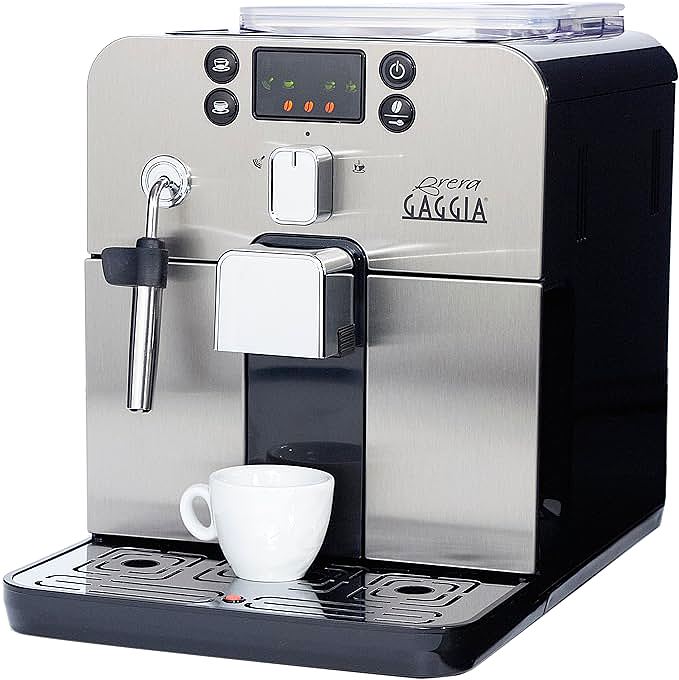
Before 1938, espresso was a brutalist affair, often a bitter, scorched liquid born from the violent force of steam. It was in the cafes of Milan that a barista, Achille Gaggia, obsessed over a more elegant solution. He envisioned a coffee extracted not with scalding steam, but with pure, hot water under immense hydraulic pressure. His invention, a piston-driven system, inadvertently created something revolutionary: a fine, reddish-brown foam floating atop the coffee. He named it crema, and in doing so, transformed espresso from a simple beverage into a complex science. This is the spirit captured within the mechanisms of modern machines, and few make that science as accessible as the Gaggia Brera.
To understand the Brera is to dissect the scientific principles it automates. It is a compact countertop laboratory, designed to control a series of delicate transformations with precision. This is not merely an overview of a coffee machine; it is an exploration of the material science, thermodynamics, and fluid dynamics that must be mastered to turn a simple bean into a perfect cup. We will use the Brera as our scalpel to reveal the hidden physics behind the daily ritual of espresso.

The First Transformation: Preserving Potential via Material Science
The conversation between you and your coffee begins with a shattering moment: the grind. Inconsistency here is the primary enemy of good extraction. Uneven grounds create a disastrous phenomenon known as “channeling,” where water exploits weak spots in the coffee puck, over-extracting some grounds to bitterness while leaving others untouched and sour. The Specialty Coffee Association’s research highlights that a uniform particle size is paramount for achieving a balanced extraction.
The Brera’s first scientific instrument addresses this challenge directly: its flat ceramic burr grinder. The choice of ceramic is a deliberate feat of material science. Unlike steel burrs, which can heat up from friction and prematurely “bake” the volatile aromatic compounds out of your coffee, ceramic is a thermal insulator. It remains cool, preserving the bean’s delicate integrity. Key flavor compounds in coffee are notoriously fragile; for instance, some of the most desirable floral notes are carried by compounds that degrade at temperatures easily reached by a hard-working steel grinder. Ceramic’s superior hardness also ensures the burrs maintain their sharp, precise edges for longer, delivering a uniform grind year after year. It doesn’t just chop the beans; it mills them with scientific precision.
This mechanical precision is guided by an electronic brain: the Gaggia Adapting System. Think of this as a digital barista with an intuitive sense of touch. It effectively acts as a torque sensor, “listening” to the physical properties of the beans. A dark, brittle roast will shatter with less resistance than a dense, light roast. The adapting system senses this resistance and adjusts the grinder’s rotational speed and duration, ensuring a consistent volume and density of grounds is prepared for extraction every time. It automates the intuition a professional barista develops over thousands of hours, ensuring your shot is based on a consistent foundation, regardless of the beans you choose.
But a perfectly uniform grind is merely potential energy. To unlock the soul of the coffee, we must introduce the twin catalysts of extraction: precise temperature and immense pressure. This is where the Brera transitions from a miller to an alchemist.

The Heart of Extraction: The Physics of Pressure and Temperature
The Italian Espresso National Institute defines a certified espresso as one extracted with water at 88 ± 2°C under a pressure of 9 ± 1 bars. Hitting this narrow window is the central challenge of any espresso machine.
The Brera’s process begins with a gentle prelude: pre-infusion. Before applying full pressure, the machine wets the ground coffee with a low-pressure stream of water. This isn’t a wasted step; it’s a crucial stabilizing action. It allows the coffee grounds to swell and settle, eliminating dry pockets and creating a more uniform density throughout the puck. This simple action drastically reduces the risk of channeling and ensures that when the full force of the water arrives, it flows evenly through the entire bed of coffee. It’s a gentle wake-up call before the main event.
Next comes the pressure. While the Brera’s pump is rated at 15 bars, this is a measure of its maximum potential power, not the pressure your coffee actually experiences. The true extraction pressure is a dynamic equilibrium created by the pump’s force pushing against the resistance of the finely ground, tamped coffee puck. The machine is engineered to ensure this equilibrium point lands squarely within the ideal 9-bar range. This pressure is immense, forcing water to saturate the coffee grounds and emulsify the natural oils and lipids within, creating the signature, persistent crema that Achille Gaggia first discovered.
Controlling temperature in a compact, single-boiler machine presents a unique thermodynamic puzzle. Brewing espresso and steaming milk require two very different temperatures (around 90°C for brewing, and well over 100°C to produce steam). The Brera employs Rapid Steam Technology to manage this. This system uses a powerful, lightweight boiler that can be heated or cooled very quickly. It’s an act of engineering compromise; it’s not instantaneous, but it dramatically minimizes the downtime between brewing a shot and being ready to froth milk, a common frustration with less sophisticated single-boiler machines.
The Final Flourish: Engineering the Perfect Cloud with Fluid Dynamics
The journey could end here, with a flawless shot of espresso. But for many, this is just the canvas. The final act of creation involves a phenomenon of pure physics: transforming liquid milk into a velvety cloud. This is not magic; it is a masterclass in fluid dynamics, happening at the tip of the Pannarello steam wand.
A traditional steam wand requires significant skill from the barista to introduce the right amount of air at the right time. The Pannarello is a clever piece of engineering that simplifies this process. As high-pressure steam exits the wand, it passes over a tiny intake hole on the side of its outer sheath. According to the Venturi effect, a principle of fluid dynamics, the high velocity of the steam creates a low-pressure zone, which actively siphons air from the outside into the steam flow. This air is then violently sheared into microscopic bubbles by the turbulent steam. The proteins in the milk wrap around these bubbles, creating a stable, dense, and velvety microfoam. It is an engineered solution that trades the artisan’s manual control for consistency and ease of use, reliably producing the rich foam needed for lattes and cappuccinos.

Conclusion: The Countertop Laboratory
The Gaggia Brera is more than an appliance; it’s an embodiment of nearly a century of coffee science, distilled into a form accessible to the home user. It doesn’t ask you to be a master barista. Instead, it takes the foundational principles mastered by generations of them—the importance of a uniform grind, the necessity of stable temperature and pressure, and the physics of perfect foam—and automates them through clever engineering.
Understanding the material science behind its ceramic grinder, the physics at play during its pre-infusion and extraction, and the fluid dynamics engineered into its steam wand allows you to appreciate the machine on a deeper level. It’s a reminder that the quest for the perfect cup is a journey of passion, innovation, and science. With every press of a button, you are not just brewing coffee; you are engaging with a legacy, running a repeatable experiment in flavor, all from the convenience of your own countertop laboratory.
