It begins with a gentle hiss, a subtle promise whispered from the stovetop. Soon, it swells into a determined gurgle, a rhythmic percussion that culminates in a fragrant eruption. For millions, this is the daily soundtrack of waking up: the sound of a Moka pot. This humble, eight-sided aluminum icon, a fixture in kitchens from Naples to San Francisco, seems wonderfully simple. But contained within its metallic shell is a spectacle of raw physics—a tiny, controlled volcano powered by the fundamental laws of thermodynamics and fluid dynamics. To truly understand this kitchen alchemist, we must look past its charming exterior and see it for what it is: a beautiful, miniature heat engine.
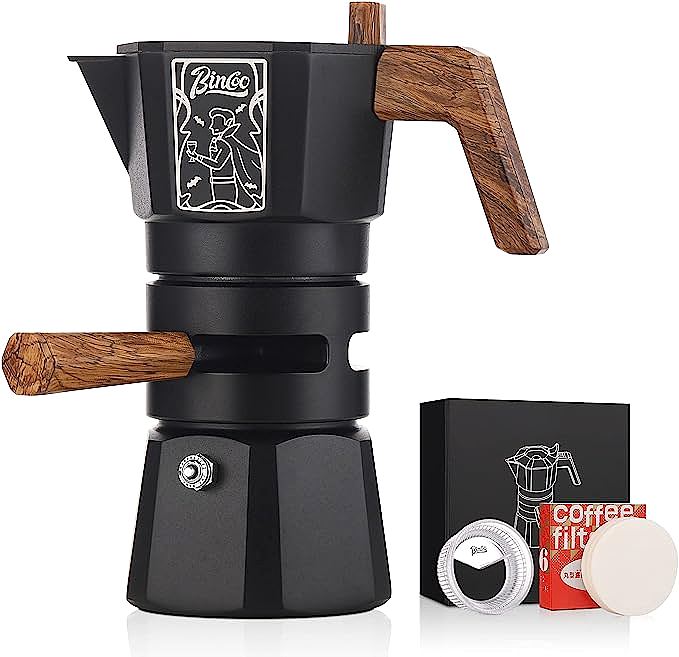
But what if this classic, nearly century-old design could be refined? What happens when modern engineering principles are applied to this icon of coffee culture? This is not merely a question of aesthetics, but one of control. We will explore this by dissecting a fascinating specimen: the Bincoo GYKF0540. Consider this not a product review, but a case study—an autopsy of an attempt to tame the beautiful, wild nature of the Moka pot.
The Engine Room: Deconstructing Moka Pot Physics
At its heart, the Moka pot’s operation is a textbook demonstration of the Ideal Gas Law (PV=nRT). When you place the pot on a heat source, you are feeding energy into a closed system. Inside the bottom chamber, a fixed amount of air is trapped above the water. As the water heats, it transfers energy to this air and begins to vaporize, dramatically increasing the pressure inside. This pressure, building to around 1.5 to 2 bars, becomes the engine. It is the invisible hand that pushes hot water up a funnel, against gravity, on its journey to becoming coffee. It’s a thermal siphon: a crude but effective system where heat creates the motive force for fluid movement.
But this elegant, self-propelled engine, for all its charm, has a wild side. Its power is untamed. Left unchecked, the very forces that create our coffee can conspire to ruin it. This leads us to the two inherent perils of the classic Moka pot design: the chaos of channeling and the bitterness of over-extraction.

The Dual Perils: Channeling and Over-Extraction
Once the pressure is great enough, hot water is forced into the bed of coffee grounds. This coffee bed is a “porous medium,” and the water’s journey through it is a delicate dance. Ideally, the water should percolate evenly through all the grounds. But the eruptive, often unstable pressure from the bottom chamber can blast pathways of least resistance through the coffee puck. This is “channeling.” It results in a disastrously uneven extraction: some grounds are stripped bare of all their flavor, contributing harshness, while others are barely touched.
Herein also lies the Moka pot’s second inherent peril: temperature. The process is self-accelerating. As water is pushed out, the remaining water and air in the bottom chamber get even hotter. Towards the end of the brew, what’s left is sputtering, superheated steam. If this steam, far above the ideal brewing temperature range of 90-96°C, blasts through the coffee, it acts as a brutish solvent. It rips out the last, most stubborn compounds—often harsh, bitter alkaloids and chlorogenic acid lactones. This is the moment a delicious brew turns acrid. Taming this final, chaotic stage is the holy grail of Moka pot mastery.
The Modern Intervention: An Engineering Case Study of the GYKF0540
For decades, controlling these chaotic processes was left to the user’s skill. But how can engineering intervene? This is where the Bincoo GYKF0540 serves as our fascinating case study, as it attempts to impose order with two key innovations.
First, to tame the pressure, the Bincoo model introduces a dual-valve system. A traditional pot has a simple open spout. The Bincoo, however, places one valve to regulate water flow into the grounds, and a second to control the exit of the brewed coffee. In principle, this system acts like a dam and a sluice gate, aiming to transform the uncontrolled eruption into a more managed, stable flow. By maintaining a more constant pressure within the coffee bed, it seeks to reduce the likelihood of channeling and promote a more even, consistent extraction.
Second, to tame the temperature, the Bincoo incorporates a “thermostat extractor.” While the exact mechanism is proprietary, its function is clear: to act as a thermal circuit breaker. It is designed to sense when the process is reaching its destructive, superheated steam phase and to somehow halt or dramatically reduce the energy input. It’s an attempt to automate the barista’s intuition, ensuring the chemical dialogue ends on a pleasant note, before the bitter compounds are unleashed.
The Price of Precision: Inescapable Engineering Trade-offs
In theory, these interventions transform the Moka pot from a barely controlled eruption into a managed chemical process. It is a beautiful vision of engineering control. However, as any engineer knows, every solution introduces a new set of challenges. This is the unavoidable price of precision.
The most significant is the tyranny of the seal. A system designed to better manage pressure is naturally less forgiving of an imperfect seal. User feedback for the GYKF0540 is revealing, with multiple reports of needing to screw the chambers together with significant force to prevent leaks and spraying. This isn’t a simple flaw; it is a direct consequence of the design’s ambition. To hold a stable, elevated pressure, mechanical tolerances must be high, and the mating surfaces of the screw threads and gaskets must form a near-perfect seal. Any imperfection, be it a stray coffee ground or a slightly misaligned thread, can become a point of catastrophic failure for that brew.
Furthermore, material science plays a crucial role. The classic Moka pot is made of aluminum, a material chosen for its excellent thermal conductivity of around 205 W/m·K, which allows the base to heat up quickly and evenly. (For comparison, stainless steel’s conductivity is a paltry ~15 W/m·K). However, aluminum is not ferromagnetic, a property required for an induction stovetop to work. This renders the Bincoo, like many of its aluminum brethren, incompatible with an increasingly common kitchen appliance. The choice of material becomes a balance between thermal performance and modern convenience, a compromise baked into the very metal of the pot.
Conclusion: From Simple Icon to Complex Instrument
The journey of the Moka pot from a simple, eight-sided icon to a modern, valve-regulated device like the Bincoo GYKF0540 is a tale of engineering ambition. It is a shift from a simple, robust appliance into a more complex, sensitive instrument.
The Bincoo represents a fascinating attempt to impose order on chaos, to solve the inherent physical challenges of the Moka pot with clever engineering. Yet, in doing so, it demands more from its user: more strength to ensure a seal, more patience to learn its quirks, and a specific type of stovetop. It reminds us that in the world of design, there are no free lunches—only trade-offs. The quest to perfect this little heat engine, whether through a barista’s practiced hand or an engineer’s clever valve, is a testament to our unending desire to dance with the laws of physics to create something truly wonderful. It leaves us with a choice: do we prefer the reliable charm of a classic car, or the high-performance, high-maintenance thrill of a finely-tuned racing machine?
