That first sip of perfectly brewed coffee in the morning… it’s a ritual, a comfort, a necessity for many of us. But often, the journey from bean to cup feels like a game of chance, dictated by a machine we don’t fully understand. We look at its control panel, see buttons like ‘Program’, ‘Cups’, and that most enigmatic of all: ‘Bold’. We press it, hoping for a richer, more intense brew, but what did we actually just do?
What if I told you that your coffee maker isn’t just a simple appliance? It’s a cockpit. And that ‘Bold’ button, far from being a marketing gimmick, is one of the most important instruments on your control panel. It’s a dial that directly controls the fourth dimension of coffee extraction: time.
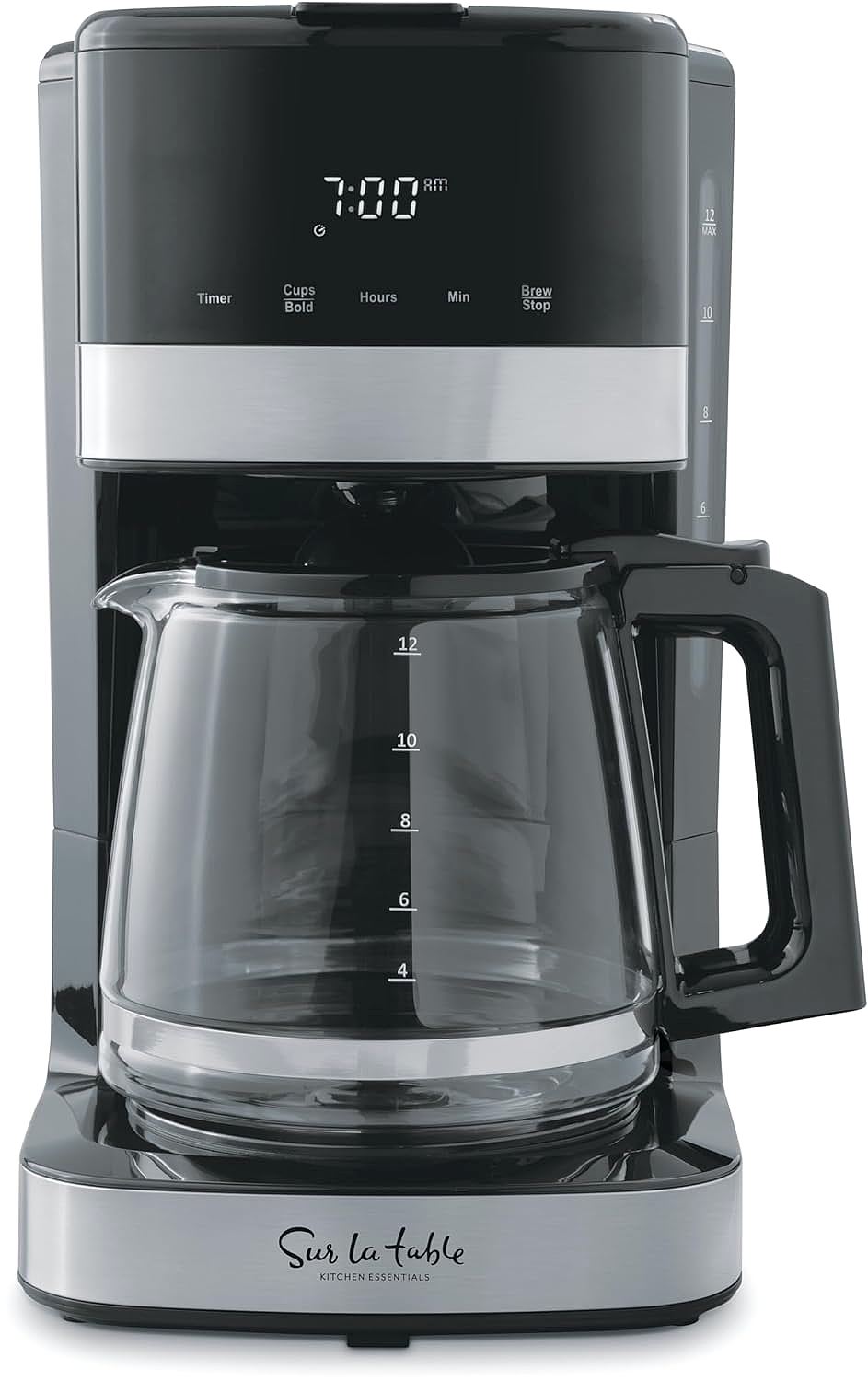
By understanding what each button in this cockpit truly commands, you can seize control of your morning brew. You can transform it from a consistently mediocre experience into a consistently magnificent one. And you don’t need a thousand-dollar machine to do it. To demonstrate, we’ll use the Sur La Table SE-4100—an affordable and surprisingly capable programmable coffee maker—as our flight simulator. But the principles you learn today will apply to almost any modern drip coffee machine you command, whether it’s from Cuisinart, Hamilton Beach, or Mr. Coffee. Let’s power on.

The Engine Start: Power, Water, and the Science of Heat
Before we can fly, we need to start the engines. On a coffee maker, this is the deceptively simple “Brew” button. When you press it, you’re not just flipping a switch; you’re initiating a complex thermal process. The machine’s 1000-watt heating element—the engine core—springs to life, rapidly heating the water you’ve added to the reservoir.
This isn’t just about making water hot; it’s about hitting a very specific target. The Specialty Coffee Association (SCA), the leading authority on coffee quality, has determined that the optimal water temperature for extracting the best flavors from coffee grounds is between 92°C and 96°C (197.6°F and 204.8°F).
Why this specific range? It’s the sweet spot where desirable flavor compounds like esters and ketones dissolve readily, while less desirable ones that cause excessive bitterness are slower to emerge.
Too low, and your coffee will taste sour and weak (a phenomenon called under-extraction). Too high, and it will be bitter and harsh (over-extraction). While budget-friendly machines like the SE-4100 may not have the precision of high-end, copper-boil systems, their powerful 1000W engines are specifically engineered to propel the water into this critical flavor zone.
Your First Command (Actionable Tip): Always, always start with cold, filtered water. Using hot water might seem like a shortcut, but it confuses the machine’s heating cycle and can prevent it from reaching the optimal extraction temperature. Filtered water is just as crucial; chlorine and excess minerals in tap water will mask the delicate flavors of your coffee, no matter how perfectly it’s brewed.
The Main Event: Demystifying the ‘Cups/Bold’ Button
Now that the engine is warm and we have optimal water temperature, it’s time to engage the most powerful, and most misunderstood, control on our panel: the ‘Bold’ button. This isn’t just about strength; it’s about time.
Here is the secret: the ‘Bold’ button doesn’t magically create stronger coffee. Instead, it subtly alters the brewing process. It instructs the machine to pulse the hot water over the coffee grounds more slowly. This simple change has a profound impact because it increases the contact time—the total duration the water and coffee grounds are interacting.
Think of brewing coffee like steeping a tea bag. If you pull it out too soon, the tea is weak and watery. If you leave it in for too long, it becomes bitter and tannic. Coffee extraction works on the exact same principle. The goal is to keep the water in contact with the grounds just long enough to dissolve all the desirable compounds (which give coffee its sweetness, acidity, and complexity) without starting to dissolve the undesirable ones (which cause bitterness).
When you press ‘Bold’, you are extending that steeping time, allowing for a fuller, more thorough extraction. This results in a brew with more body and a more intense flavor profile. The regular setting, conversely, uses a faster flow rate for a milder, lighter-bodied cup.
Taking Control of Time (Actionable Tip): The ‘Bold’ button is your primary tool for fine-tuning extraction. Is your coffee tasting a little thin or sour? You might be under-extracting. Try using the ‘Bold’ setting, or a slightly finer grind, to increase contact time. Is your coffee tasting overly bitter? You might be over-extracting. Switch back to the regular setting, or use a slightly coarser grind. This single button gives you a remarkable degree of control.
The Flight Plan: Programming Your Brew with the ‘Timer’
The 24-hour programmable timer seems like a feature purely for convenience, a way to wake up to the smell of fresh coffee. And it is. But in your flavor cockpit, its real superpower is consistency.
Great coffee is a product of precision and repetition. By preparing your coffee the night before—measuring your beans and water when you’re calm and unhurried—you eliminate the morning rush factor. This means your coffee-to-water ratio, a critical variable for strength, is more likely to be identical every single day. The timer then ensures the brewing starts at the exact same moment, removing one more variable from the equation. This consistency is the secret to dialing in your perfect recipe and being able to replicate it day after day.
Automating for Accuracy (Actionable Tip): Use the night-before setup not just to save time, but to improve your coffee. Use a kitchen scale to weigh your beans for ultimate consistency. Once you find a ratio you love (a great starting point is 1:16, or one gram of coffee for every sixteen grams of water), the timer ensures you can lock it in.
Navigating the Unseen: Essential Systems & Common Traps
A skilled captain knows their craft inside and out, including the systems designed for convenience that can sometimes introduce turbulence.
First, the ‘Pause and Serve’ feature. It’s a simple spring-loaded valve at the bottom of the filter basket. When you remove the carafe, its lid pushes up on the valve, sealing the opening. It’s brilliant for a quick cup, but if coffee grounds or oils build up, it can fail, leading to messy drips. Regular cleaning of this valve is essential.
Second, and far more critical, is the warming plate. This feature is a double-edged sword, and frankly, its sharp edge is the one that ruins coffee. While it keeps your brew hot, the prolonged, direct heat acts as a flavor destroyer. According to studies in food chemistry, continuous heating rapidly degrades the delicate aromatic compounds that give coffee its beautiful aroma and taste, while accelerating the formation of bitter-tasting acids. The 4-hour automatic shut-off is a safety feature, not a flavor-preservation system.
Trap Avoidance Maneuver: Treat the warming plate as a last resort. For the best flavor, aim to drink your coffee within 30-60 minutes of brewing. If you need to keep it longer, immediately transfer the brewed coffee to a pre-heated thermal carafe. This will preserve its temperature and, more importantly, its taste.

The Post-Flight Checklist: Your Maintenance Ritual
Your mission isn’t over when the coffee is brewed. A clean cockpit is a safe cockpit, and in this case, a flavorful one. Over time, coffee oils become rancid and mineral deposits (scale) from water build up inside your machine. Both will impart nasty, off-flavors into your coffee and can eventually damage the heating element.
- Daily: Rinse the carafe and filter basket with warm water.
- Weekly: Wash all removable parts with warm, soapy water to remove coffee oil residue.
- Monthly (or as needed): Descale your machine. Run a brew cycle with a solution of equal parts white vinegar and water, followed by two full cycles of fresh water to rinse it thoroughly. This removes the mineral buildup you can’t see.

Conclusion: You Are the Captain of Your Brew
That ‘Bold’ button is more than just a setting; it’s a symbol. It represents the hidden layer of control that modern, affordable coffee makers have placed at your fingertips. It’s an invitation to move beyond simply being a passenger and to become the captain of your own brew.
You now understand that the buttons in your coffee maker’s cockpit correspond to the fundamental principles of coffee science—temperature, time, and consistency. You know how to use them to steer your extraction toward sweetness and away from bitterness. And you know how to avoid common traps like the dreaded warming plate.
The power to brew a truly great cup of coffee was never in the price tag of the machine. It was always in your hands. Go experiment. Take control. Your perfect morning is waiting for your command.
