Brewing coffee is, at its fundamental level, an exercise in chemistry. It is the controlled dissolution of soluble compounds—lipids, acids, sugars, and caffeine—from a solid matrix into a liquid solvent. The most critical variable in this equation, yet often the most overlooked, is Surface Area.
To control the rate of this chemical reaction, we must manipulate the geometry of the coffee bean. This is the domain of Granulometry (the measurement of particle size). While boiling water and buying expensive beans are important, without a precise mechanism to fracture those beans into uniform particles, the extraction becomes chaotic. This is why the transition from a “blade grinder” (which chops randomly) to a “burr grinder” (which crushes systematically) is the single most significant upgrade a home barista can make.
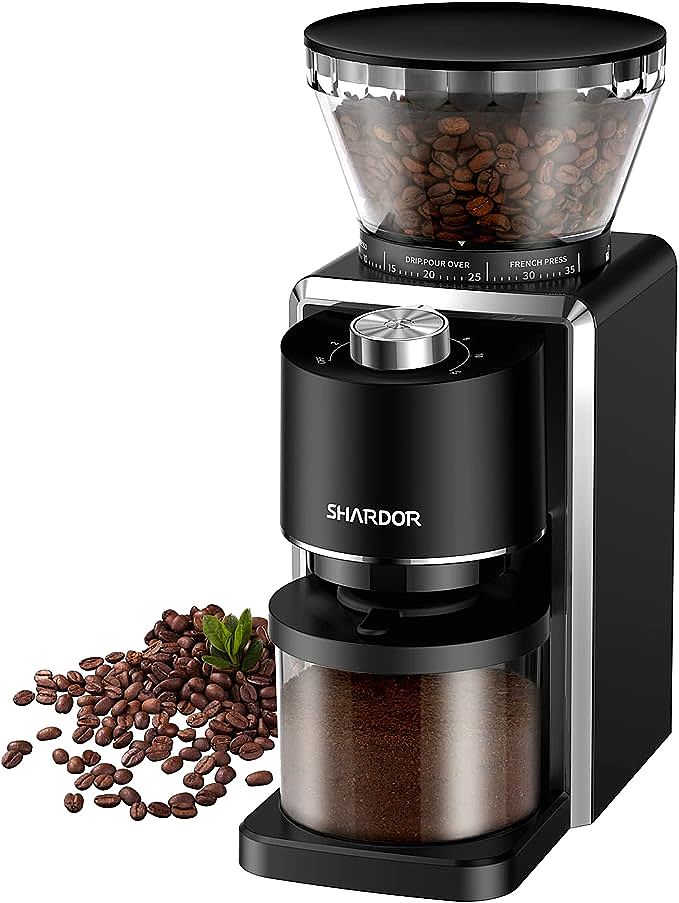
The SHARDOR CG9406-UL2 serves as a pertinent case study in this mechanical transition, employing stainless steel conical burrs to impose order on the chaotic structure of the coffee bean.

The Geometry of Crushing: Conical Burrs Explained
Why do professionals reject blade grinders? A blade grinder works by probability; it hits beans randomly, resulting in a mix of “boulders” (large chunks) and “fines” (dust).
* Boulders under-extract, leading to sourness.
* Fines over-extract, leading to bitterness.
The resulting cup is a muddled confusion of both flavors.
The SHARDOR unit utilizes Stainless Steel Conical Burrs. This system relies on two nesting cones—a rotating inner burr and a stationary outer ring.
1. Gravity Feed: Beans are drawn down into the gap between the burrs.
2. Progressive Reduction: The teeth on the burrs get progressively smaller towards the bottom. Beans are cracked, then crushed, then refined.
3. The Result: This creates a tighter Particle Size Distribution. While no grinder produces perfectly identical particles, conical burrs naturally produce a “bimodal distribution”—two peaks of particle sizes. This is actually desirable for texture, providing both the fines necessary for body (mouthfeel) and the larger particles for flavor clarity.

The Triboelectric Challenge: Fighting Static
One of the most persistent complaints in coffee grinding is static cling. When coffee beans are fractured at high speed, electrons are transferred between particles, creating a static charge (The Triboelectric Effect). This causes grounds to fly out of the bin, stick to the walls, and create a mess.
The SHARDOR CG9406-UL2 markets an Anti-Static technology. From an engineering standpoint, this typically involves using conductive materials in the exit chute or optimizing the discharge path to neutralize the charge before the grounds hit the plastic bin. Reducing static isn’t just about cleanliness; it’s about Dosing Accuracy. If 1 gram of your 18-gram dose is stuck to the walls of the bin, your brew ratio is thrown off, altering the concentration of the final cup.

Calibration and Range: 35 Settings
The requirement for “35 settings” is not marketing fluff; it is a necessity of Extraction Yield.
* Espresso: Requires a fine grind to create high resistance against 9 bars of water pressure. If the particles are too coarse, water channels through, creating a weak, underextracted shot.
* French Press: Requires a coarse grind to minimize surface area during the long (4-minute) immersion steep.
The Engineering Constraint:
It is important to note a physical limitation of entry-level conical burr grinders often mentioned in technical analysis. As you adjust to the coarsest settings (for French Press), the burrs move further apart. In many designs, this looseness allows the inner burr to wobble slightly (Axial Runout). This wobble can introduce inconsistency at the coarse end of the spectrum. While the SHARDOR covers the full range, users typically find the “sweet spot” of consistency in the medium-to-fine range (Drip to Espresso-style), where the burrs are held tighter together, stabilizing the shaft.
Thermal Management and Oxidation
Heat is the enemy of coffee. High-speed friction can heat the grounds, beginning the “cooking” process before water is even added, leading to a loss of volatile aromatics.
Stainless steel burrs are generally efficient at dissipating heat compared to ceramic, especially in short bursts. The Auto-Shutoff feature (based on a timer or cup selection) further mitigates heat buildup by preventing the motor from running unnecessarily.
Furthermore, the Cleaning Protocol is vital. Coffee oils oxidize and turn rancid (polymerize) over time. A grinder with a removable upper burr allows for mechanical removal of these stale oils. If not cleaned, this residue acts as a contaminant, imparting a stale, cardboard-like flavor to even the freshest beans.
Conclusion: The Gateway to Precision
The SHARDOR CG9406-UL2 represents a specific tier of coffee equipment: the gateway from chaos to order. It replaces the randomness of a blade with the calculated geometry of a burr. While it may not offer the micron-level precision of commercial equipment costing ten times as much, it fundamentally changes the physics of your morning routine. It allows you to treat coffee not as a commodity, but as a variable to be dialed in, controlled, and perfected.
