In the world of outdoor adventure and mobile living, one luxury remains stubbornly difficult to untether from the grid: a truly hot, high-pressure cup of coffee. While we have miniaturized computers into watches and communication towers into pockets, the physics of boiling water remains immutable. It is a problem of thermodynamics, not just electronics.
The challenge is simple to state but difficult to solve: water is incredibly energy-hungry. To take a fluid from ambient temperature to the precise extraction point required for espresso involves a massive transfer of energy. For decades, “portable” coffee meant a thermos of lukewarm liquid or a manual pump requiring a separate kettle. But a new wave of engineering is attempting to break this barrier, placing the power of a heating element into a handheld, battery-operated device. This article explores the science behind this thermal feat.

The Specific Heat Problem
To understand why battery-powered heating is an engineering marvel, we must look at Specific Heat Capacity. Water has a specific heat of approximately 4.18 Joules per gram per degree Celsius. This is unusually high compared to other substances. It means that to raise just 50 milliliters (50 grams) of water from a camping ambient temperature of 10°C to an extraction temperature of 96°C, you need to input a significant amount of energy—roughly 18,000 Joules, assuming perfect efficiency (which never exists in the real world).
In a kitchen, a 1500-watt kettle draws this energy from the wall effortlessly. In a portable device, this energy must be drawn from a lithium-ion cell. The rate of discharge (power) and the total storage (capacity) become the limiting factors. This is why early attempts at electric portable makers failed; they either couldn’t reach the temperature, took 20 minutes to do so, or died after a single ounce of brewing.
Battery Density vs. Thermal Demand
The engineering bottleneck lies in the “C-rating” of batteries—the rate at which they can safely discharge energy without overheating or degrading. Heating an element requires high amperage. A standard USB bank outputting 5V at 2A (10 Watts) is woefully insufficient. It would take nearly 45 minutes to heat a shot of espresso at that rate, by which time heat loss to the environment would likely equal the heat input, resulting in water that never boils.
To achieve boiling temperatures in a reasonable timeframe (under 5 minutes), a portable electric espresso machine requires an internal power architecture closer to a power tool than a phone charger. It needs to run at higher voltages or support high-drain currents to drive a heating element at 80-100 Watts. This necessitates a sophisticated Battery Management System (BMS) to balance the cells and prevent thermal runaway while delivering this “burst” of thermal energy.
Case Study: Ceramic Heating Efficiency (The CERA+ Protocol)
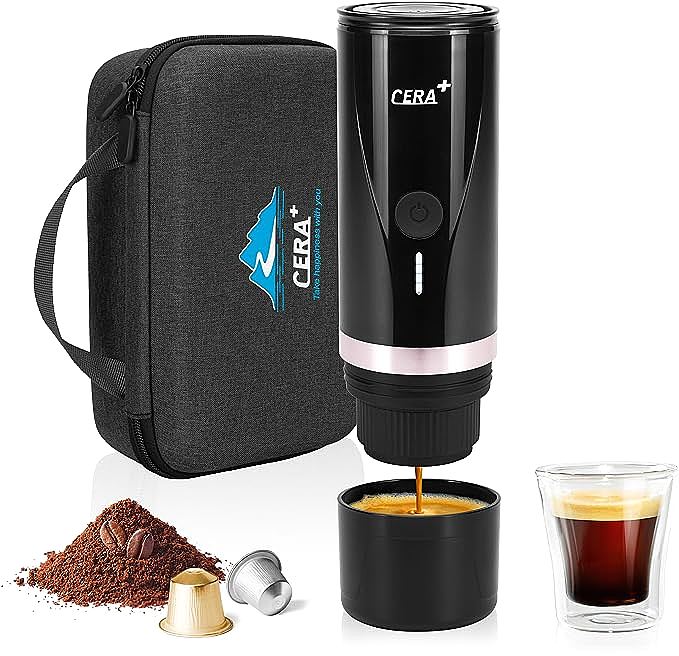
Current state-of-the-art solutions address this calculating the precise balance between water volume and battery mass. A prime example of this optimization is the CERA+ PCM03. This device illustrates how modern engineering navigates the thermal constraints we’ve discussed.
The PCM03 utilizes a ceramic heating technology, chosen for its rapid thermal conductivity and electrical insulation properties. By drawing 90 Watts of power from its internal 7800mAh lithium-ion battery array, it can raise water to 96°C (205°F) in approximately 3 to 4 minutes. This 90W draw is the critical spec—it is high enough to overcome environmental heat loss but managed carefully to preserve battery health.
The device’s architecture acknowledges the physics: it limits the water chamber to 80ml. This isn’t an arbitrary restriction; it’s a thermodynamic calculation. Heating 80ml is achievable with the onboard energy storage; heating 300ml would require a battery too heavy to be “portable.” The PCM03 represents the equilibrium point where portability meets thermal utility.

The 96°C Target
Why is hitting 96°C so important? Coffee chemistry is temperature-dependent. Below 90°C, acidic compounds dissolve readily, but the sugars and heavier oils that provide body and sweetness extract poorly, leading to a sour, thin cup. Above 96°C, tannins extract too quickly, causing bitterness.
In the PCM03, intelligent sensors monitor this climb. The user interface uses LED indicators to show the temperature progression—from 20°C up to the 96°C target. This feedback loop ensures that the extraction phase (the pump activation) only triggers when the thermal energy is sufficient to facilitate proper chemical bonding between the water and the coffee grounds.
Endurance Calculations
The “cost” of this heating is measured in battery life. Thermodynamics dictates that you cannot cheat the energy bill. The PCM03’s 7800mAh battery can heat cold water for approximately 4 to 5 cups (at 50ml each) or 3 cups (at full 80ml capacity) per charge.
However, if the “heating tax” is paid by an external source—say, a campfire kettle or a gas stove—the device’s efficiency skyrockets. When using pre-boiled water, the battery only needs to power the 20-bar pump and logic circuits. In this “Cold Water vs. Hot Water” scenario, the endurance jumps from 3 cups to over 200 cups. This clearly demonstrates that 95% of the energy in a portable electric espresso machine is dedicated to the heater, not the motor.
Future of Mobile Thermal Dynamics
The CERA+ PCM03 shows us that true off-grid espresso is possible, but it requires a respect for physics. The 12V/24V car charging compatibility further mitigates the battery anxiety, effectively turning a vehicle into a generator for the device.
As battery energy density improves (moving from standard Li-ion to solid-state or silicon-anode technologies), we may see cup counts increase. But for now, the physics of specific heat remain the law. Devices that acknowledge this law—by optimizing heater efficiency and water volume—offer the best compromise, delivering a steaming shot of civilization in the middle of the wilderness.
