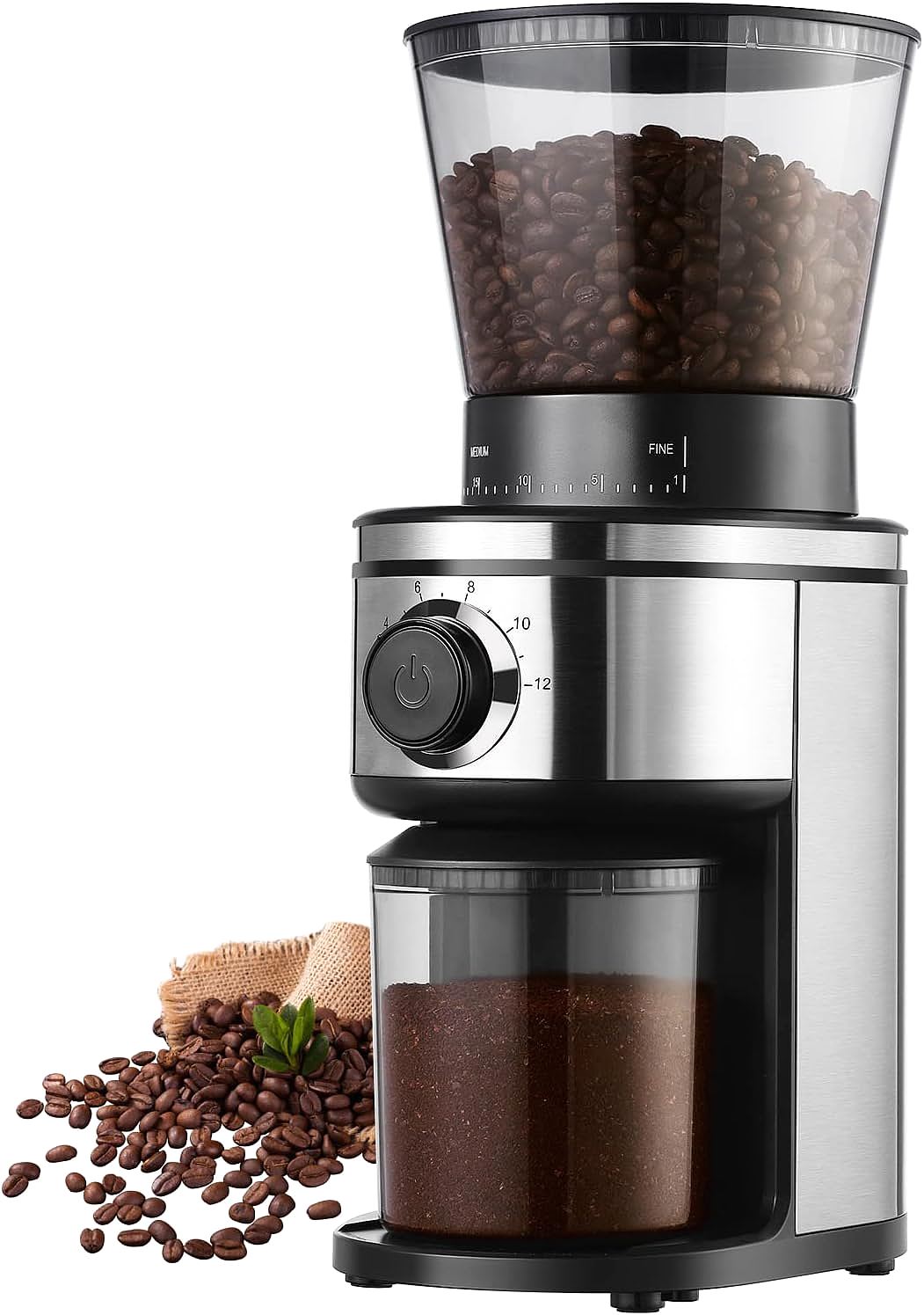
In the pursuit of the perfect cup, the most critical variable is often the one we treat most violently: the grind. Traditional blade grinders operate like blenders, spinning at 20,000 RPM, shattering beans into a chaotic mix of dust and boulders while generating immense friction heat. This heat is the enemy of flavor. It volatilizes the delicate aromatic compounds (floral, fruity notes) before water ever touches the grounds.
The Ollygrin BG702S distinguishes itself not just by using burrs, but by employing Deceleration Engineering. It utilizes a Gear Reduction Motor to slow the grinding speed down to a fraction of a blade grinder’s velocity. This fundamental shift in mechanics prioritizes torque over speed, and flavor preservation over brute force.

Thermodynamic Integrity: The Gear Reduction Advantage
Why does motor speed matter? Because friction creates heat.
* The Problem: High-speed motors transfer thermal energy directly into the coffee oils. This can initiate oxidation and “cook” the grounds, leading to a flat, metallic taste.
* The Solution: The Ollygrin’s gear reduction system steps down the RPM. This Low-Speed Grinding minimizes friction heat, keeping the beans cool. From a chemical perspective, this preserves the volatile organic compounds (VOCs) that define the coffee’s bouquet, ensuring they are released in your cup, not in the grinder.

The Geometry of Extraction: 40mm Conical Burrs
Blade grinders create “Fines” (dust) and “Boulders” (chunks). Boulders under-extract (sour), and Fines over-extract (bitter).
The BG702S uses 40mm Stainless Steel Conical Burrs.
* Particle Uniformity: The conical shape creates a progressive crushing path. Beans are broken, then milled, then refined. This produces a tight Particle Size Distribution (PSD).
* Extraction Yield: Uniform particles allow water to extract flavor evenly from every grain. This leads to a cup with clarity and balance, rather than the muddled confusion of a blade-ground brew.

Dialing In: The 30-Setting Spectrum
Different brewing methods rely on different flow rates, which are dictated by grind size. The Ollygrin offers 30 Macro-Steps.
* Fine (1-8): Increases surface area for high-pressure Espresso extraction.
* Medium (9-21): Balances flow and resistance for Drip and Pour-over.
* Coarse (22-30): Minimizes surface area for long-immersion French Press, preventing silt and bitterness.
This range allows you to manipulate the Hydraulic Resistance of your coffee bed, giving you control over the strength and body of your brew.

The Static Equation: Managing the Triboelectric Effect
A common complaint in user reviews is “static mess.” This is the Triboelectric Effect—friction strips electrons from dry coffee particles, causing them to repel each other and stick to plastic.
* The Variable: Static is worse in low humidity (winter).
* The Fix: While the grinder has an anti-static design, physics is stubborn. A simple hack is the “Ross Droplet Technique (RDT)”—adding a single drop of water to the beans before grinding. This increases surface conductivity, dissipating the charge and keeping your counter clean.
Mechanical Safety: The Friction Clutch
What happens if a stone hides in your beans? In a direct-drive grinder, the motor burns out.
The Ollygrin features a Friction Clutch. If a hard object jams the burrs, the clutch slips, disconnecting the motor from the burrs. This mechanical fuse protects the expensive motor, ensuring the longevity of the appliance.

Conclusion: The Precision Upgrade
The Ollygrin BG702S is the bridge between “making coffee” and “brewing coffee.” By replacing chaotic chopping with calculated milling, and high-heat friction with low-speed torque, it respects the chemistry of the bean. It turns a morning chore into a precise, repeatable scientific process that yields tangibly better flavor.
