We often sacrifice quality for convenience. Nowhere is this trade-off more apparent than in the morning coffee ritual. The single-serve brewer promises a hot cup in minutes, but far too often, it delivers a beverage that is hot, brown, and disappointing.
Why does this happen? It’s not magic; it’s physics. The standard single-serve machine is often fighting against the fundamental laws of coffee extraction.
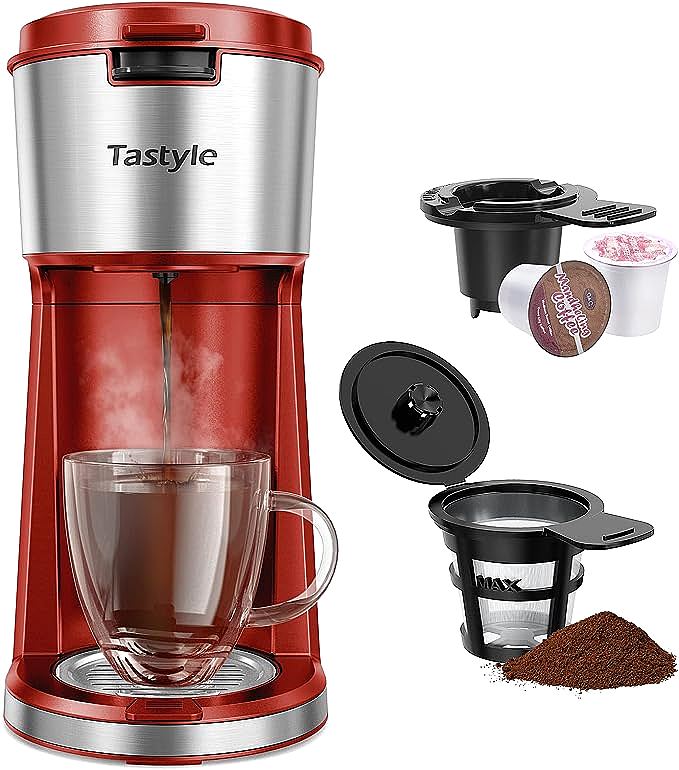
To get a cup that actually tastes like coffee, you need to stop looking at your machine as a magic box and start understanding it as a chemical reactor. By analyzing the engineering choices in versatile machines like the Tastyle Single Serve Coffee Maker (Model 8), we can decode the science behind extraction ratios, contact time, and machine longevity.
The Math of “Watery” Coffee: The Dosage Problem
The most common complaint with single-serve brewers is that large cups (12oz or 14oz) taste weak. The culprit is the Coffee-to-Water Ratio.
According to the Specialty Coffee Association (SCA), the “Golden Cup” standard requires a ratio of approximately 1:15 to 1:18 (1 gram of coffee for every 15-18 grams of water).
Let’s look at the math of a standard K-Cup:
* Standard Pod: Contains ~10-12 grams of coffee.
* 14oz Brew: Equals ~415 grams of water.
* The Resulting Ratio: 1:35 to 1:41.
This is physically impossible to brew well. You are running twice as much water through the grounds as you should, resulting in severe over-extraction (bitterness) followed by extreme dilution (wateriness).
The Engineering Solution: Volume Capacity
This is where hardware specs translate directly to flavor. The Tastyle brewer features a large-capacity ground basket rated for 25 grams (0.9 oz).
Let’s rerun the math with the 25g basket:
* Grounds: 25 grams.
* 14oz Brew: ~415 grams of water.
* The Resulting Ratio: 1:16.6.
Bingo. By physically accommodating a larger mass of coffee, the machine allows you to brew a large travel mug that actually hits the Golden Cup standard. When evaluating any single-serve machine, the basket capacity is the single most important spec for anyone who drinks more than 8oz at a time.
Decoding “Bold”: The Physics of Contact Time
Many machines, including the Tastyle, feature a “Bold” button. But what does it actually do? It doesn’t magically add caffeine. It manipulates Contact Time and Turbulence.
In a standard “Regular” cycle, the pump pushes water through the heating element and over the grounds at a consistent, rapid flow rate to maximize speed. This is fine for dark roasts that extract easily, but lighter roasts often end up sour (under-extracted) because the water rushed past too quickly to dissolve the complex sugars and acids.
When you press “Bold,” the machine typically engages a Pulse Brewing algorithm.
1. Pre-Infusion: It releases a small amount of water to wet the grounds and then pauses. This allows the coffee to “bloom” (release CO2 gas), which prepares the bed for even extraction.
2. Pulsed Flow: Instead of a continuous stream, the water is delivered in bursts. This extends the total Contact Time between the water and the coffee without using more water. It allows the water to soak deeper into the grounds, pulling out the heavier, richer compounds that give coffee its “body.”
If you are using premium beans, the “Bold” setting isn’t just a flavor preference; it’s a technical requirement to get your money’s worth out of the bean.
The Chemistry of Longevity: Why Heat Matters for Descaling
The silent killer of all coffee machines is Limescale (Calcium Carbonate). It insulates the heating element (1000W in the Tastyle’s case), forcing it to work harder and eventually causing it to burn out.
Most machines have a “Descale” light, which is just a timer. But the Tastyle offers a Heated Descaling Mode. Why does the heat matter?
We turn to chemistry’s Arrhenius Equation, which states that the rate of a chemical reaction typically increases exponentially with temperature.
* Cold Descaling: Running room-temperature citric acid through a machine works, but it’s slow. It might not dissolve the hard mineral crust baked onto the heater.
* Heated Descaling: By heating the descaling solution (citric acid + water), the machine drastically increases the energy of the molecular collisions between the acid and the calcium.
* Reaction: 3Ca(HCO_3)_2 + 2C_6H_8O_7 \xrightarrow{\Delta} Ca_3(C_6H_5O_7)_2 + 6CO_2 + 6H_2O
* The “\Delta” symbol represents heat. By activating this specific mode (holding two buttons for 3 seconds), the machine runs a cycle designed to maximize this chemical reaction, clearing the internal arteries of the brewer more effectively than a standard flush.
Designing for the Real World
Beyond the physics of brewing, the physical form factor dictates usability. The “single-serve” concept is often synonymous with “on-the-go.”
- The Travel Mug Factor: The Tastyle is designed with a clearance for mugs up to 6.7 inches tall. This seems like a minor detail until you try to wedge a standard Contigo or Yeti under a machine that’s too short. The ability to brew directly into your commute vessel preserves heat (thermal mass) and saves you from washing an intermediate transfer cup.
- The 2-in-1 Flexibility: The debate between K-Cups (convenience) and Grounds (quality/cost) is resolved by supporting both. From a cost perspective, grounds are roughly 50% cheaper per cup than pods. From a quality perspective, fresh grounds (using that 25g basket) will always win on flavor.
Conclusion: Look Beyond the Case
When shopping for a coffee maker, look past the color and the brand name. Look at the basket size—can it hold enough coffee for the cup size you want? Look for pulse brewing (Bold mode) to ensure proper extraction. And look for maintenance features that understand the chemistry of scale.
The Tastyle Single Serve Coffee Maker serves as an excellent example of how these engineering principles come together in a budget-friendly package ($~35). It doesn’t rewrite the laws of physics; it simply gives you the tools—large baskets, bold modes, and heated cleaning—to work with them.
Stop drinking watery coffee. Do the math, manage your ratios, and let physics brew you a better cup.
Portafilter Baskets: Does Size Really Matter?
This video is relevant because it visually demonstrates the impact of basket size and geometry on coffee extraction, reinforcing the article’s discussion on why the 25g basket capability is crucial for proper brewing ratios.
