Our perception of reality is biologically limited. The human eye is tuned to a tiny sliver of the electromagnetic spectrum—the “visible light” roughly between 400 and 700 nanometers. Within this narrow bandwidth, we navigate the world, assuming that what we see is what exists. But this is a deception. Just beyond the red edge of our vision lies a vast, energetic universe of Infrared Radiation (IR). In this realm, darkness does not exist. Every object possessing thermal energy—which is to say, every object in the known universe above absolute zero—is a beacon of light, broadcasting its physical state, its stress, and its internal energy through a language of heat.
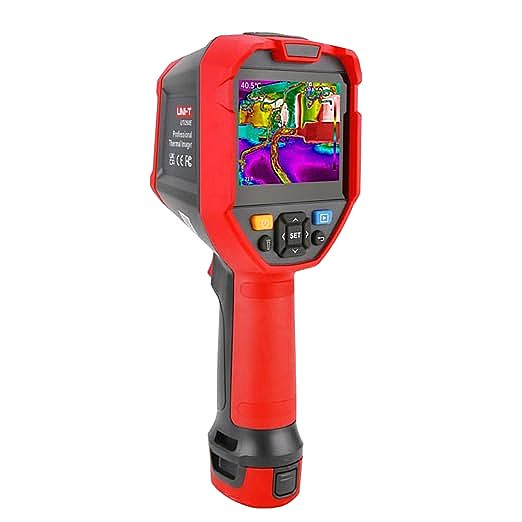
To decode this language requires a technological translator: the Thermal Imager. Devices like the UNI-T UTi720E are not merely cameras; they are radiometers. They do not capture reflected light like a standard camera; they capture emitted energy. This distinction is profound. It transforms the user from a passive observer of surfaces into an analyst of energy states. Understanding how to use such a tool effectively, however, requires more than reading a manual. It requires a journey into the physics of blackbody radiation, the material science of germanium optics, and the mathematics of spatial resolution. This article will dissect the science of the invisible, exploring how we convert photons of heat into pixels of data.
I. The Physics of the Invisible: Planck, Stefan-Boltzmann, and the Nature of Heat
Before we can appreciate the engineering of the UTi720E, we must understand what it is actually detecting. Heat is the kinetic energy of atoms vibrating. As atoms vibrate, they accelerate charged particles, which emit electromagnetic radiation.
The Blackbody Ideal and Real-World Physics
In physics, a perfect emitter of energy is called a “Blackbody.” Its radiation profile relies solely on its temperature, described by Planck’s Law.
* The Stefan-Boltzmann Law: This is crucial for thermography. It states that the total energy radiated per unit surface area of a black body is directly proportional to the fourth power of its thermodynamic temperature (E = \sigma T^4).
* Why this matters: Because of this “power of 4” relationship, a small increase in temperature results in a massive increase in radiated energy. This physical law is what allows thermal cameras to detect minute temperature differences (like 0.1°C) from a distance. The signal gets exponentially stronger as the object gets hotter.
The Atmospheric Window
Not all infrared radiation makes it through the air. Water vapor and carbon dioxide absorb many IR wavelengths. Thermal cameras like the UTi720E are specifically tuned to the Long-Wave Infrared (LWIR) band, typically 8µm to 14µm. This range is known as the “Atmospheric Window”—a spectral gap where the atmosphere is relatively transparent to IR, allowing the camera to “see” heat through the air without the signal being absorbed by humidity.

(Note: Use a spectrum diagram here)
II. The Anatomy of a Thermal Sensor: The Uncooled Microbolometer
How does the UTi720E convert invisible 10µm wavelength radiation into a 256×192 pixel image on a screen? It does not use the silicon sensors (CMOS/CCD) found in your phone, because silicon is transparent to infrared light (it doesn’t catch it). Instead, it uses a Microbolometer.
The Pixel as a Thermometer
Inside the camera is a Focal Plane Array (FPA). Each of the 49,152 pixels (256×192) in the UTi720E is actually a microscopic, thermally isolated bridge made of a material like Vanadium Oxide (VOx) or Amorphous Silicon.
1. Absorption: IR radiation hits the pixel and is absorbed, raising the temperature of that specific microscopic bridge.
2. Resistance Change: The material is a thermistor—its electrical resistance changes as it heats up.
3. Readout: The camera’s readout integrated circuit (ROIC) measures this resistance change thousands of times per second and converts it into a digital value.
This means the camera is physically “feeling” the heat of the scene pixel by pixel. This technology is “Uncooled,” meaning it operates at room temperature, which is a marvel of modern micro-electro-mechanical systems (MEMS), allowing professional diagnostics to be handheld and affordable compared to the cryogenically cooled cameras of the past.
NETD: The Noise Equivalent Temperature Difference
A critical spec for any thermal imager is its sensitivity, measured as NETD. This represents the smallest temperature difference the camera can distinguish from the background noise. A lower NETD means a “cleaner” image with less grain. For industrial inspections, a low NETD allows you to see the heat signature of a structural stud behind a drywall surface (thermal bridging) even if the temperature difference is only 0.05°C.
III. The Mathematics of Clarity: Resolution and IFOV
In the world of thermal imaging, resolution is not just about “sharpness”; it is about measurement accuracy. This brings us to the concept of Instantaneous Field of View (IFOV) or “Spatial Resolution.”
The “Spot Size” Problem
Imagine the single pixel of the UTi720E projecting out into the world. At 1 meter away, that pixel covers a certain square area of the target. At 10 meters, that square is much larger.
* Measurement Validity: To get an accurate temperature reading, the target (e.g., a hot wire) must completely fill that pixel’s field of view. If the hot wire only fills half the pixel, the detector averages the temperature of the hot wire and the cold background, giving you a dangerously low reading.
* The 256×192 Advantage: A resolution of 256×192 (nearly 50,000 pixels) provides a much smaller IFOV than entry-level 160×120 cameras. This means you can stand further away (safety) and still accurately resolve smaller targets (precision). For diagnosing a tiny Surface Mount Device (SMD) resistor on a PCB, high resolution is not a luxury; it is a necessity for accurate thermometry.
Digital Zoom vs. Optical Reality
The UTi720E offers digital zoom (2x, 4x). It is vital to understand that digital zoom does not increase resolution; it simply magnifies the pixels. The optical limit is set by the lens (often made of Germanium, a metal that is transparent to IR light but opaque to visible light) and the sensor density.
IV. The Emissivity Trap: Why Shiny Things Lie
The most common error in thermography is assuming the camera measures temperature. It does not. It measures Radiosity—the total energy coming from a surface. This energy comes from three sources:
1. Emitted: Energy radiating from the object itself (what we want).
2. Reflected: Energy bouncing off the object from the surroundings.
3. Transmitted: Energy passing through the object.
The E-Value (\epsilon)
Emissivity (\epsilon) is a measure of how efficiently an object radiates heat compared to a perfect blackbody (scale 0 to 1).
* High Emissivity: Human skin, wood, concrete, electrical tape (\epsilon \approx 0.95). These are easy to measure.
* Low Emissivity: Shiny metals like copper busbars or aluminum ducts (\epsilon < 0.2). These act like “thermal mirrors.” When you point a thermal camera at a shiny copper pipe, you aren’t seeing the pipe’s heat; you are seeing the reflection of your own body heat or the ceiling lights.
* The Correction: Professional tools like the UTi720E allow you to adjust the Emissivity setting. However, simply changing the setting doesn’t fix the physics. If emissivity is too low (<0.5), there isn’t enough emitted radiation to measure accurately. Technicians often apply “targets” (like a piece of black electrical tape) to shiny surfaces to create a high-emissivity spot for measurement. Understanding this physics is the difference between finding a fault and creating a false alarm.
V. The Fusion of Senses: Visible and Infrared Integration
Our brains are evolved to interpret visible light—shadows, textures, text. Infrared images are abstract blobs of color. To bridge this cognitive gap, the UTi720E integrates a 2MP Visible Light Camera.
Image Fusion Technology
By overlaying the edge details (from the visible camera) onto the thermal map (from the microbolometer), the device creates a Fused Image.
* Contextual Awareness: A thermal blob tells you “something is hot.” A fused image tells you “Circuit Breaker #4 is hot.” This context reduces cognitive load and interpretation errors.
* Documentation: When generating reports for clients or management, a fused image is self-explanatory. It provides the “what” (visual) alongside the “how much” (thermal). This feature relies on sophisticated software alignment (parallax correction) to match the two lenses’ viewpoints, a hallmark of modern professional imagers.
VI. Conclusion: The Instrument of Insight
The UNI-T UTi720E is more than a ruggedized tablet with a lens; it is a portable physics laboratory. It leverages the Stefan-Boltzmann law to quantify energy, uses Vanadium Oxide MEMS to sense invisible waves, and employs advanced optics to resolve spatial data.
For the professional, the value lies not just in the specs, but in the understanding of the underlying science. Knowing why a reflection happens, how resolution affects measurement distance, and what the atmospheric window implies allows the user to transcend simple “picture taking.” It turns the thermal imager into an instrument of truth, revealing the hidden energetic reality of our infrastructure. In the hands of a knowledgeable operator, it makes the invisible, actionable.
