In the landscape of home diagnostics, few metrics are as immediately critical—and frequently misunderstood—as body temperature. For decades, the ritual of “taking a temperature” was fraught with discomfort and delay: the cold glass under the tongue, the restless waiting, the uncertainty of surface skin readings. Today, the shift towards infrared technology has revolutionized this process, but speed is only half the story. To truly leverage modern tools for health management, we must understand the physiology behind the measurement.
Why has the medical community largely standardized on the ear canal? The answer lies in anatomy, not just convenience.
The Hypothalamus Connection: Why the Ear?
The goal of any thermometer is to approximate the body’s core temperature—the temperature of the blood supply surrounding vital organs—rather than the peripheral temperature of the skin, which fluctuates with the environment.
The ear canal provides a unique physiological window. Deep inside sits the tympanic membrane (eardrum), a thin tissue that shares a vascular supply with the hypothalamus. The hypothalamus is the brain’s thermoregulatory center, effectively the body’s thermostat. Because they share blood flow, the eardrum reflects changes in core body temperature more rapidly and accurately than the mouth, armpit, or rectum.
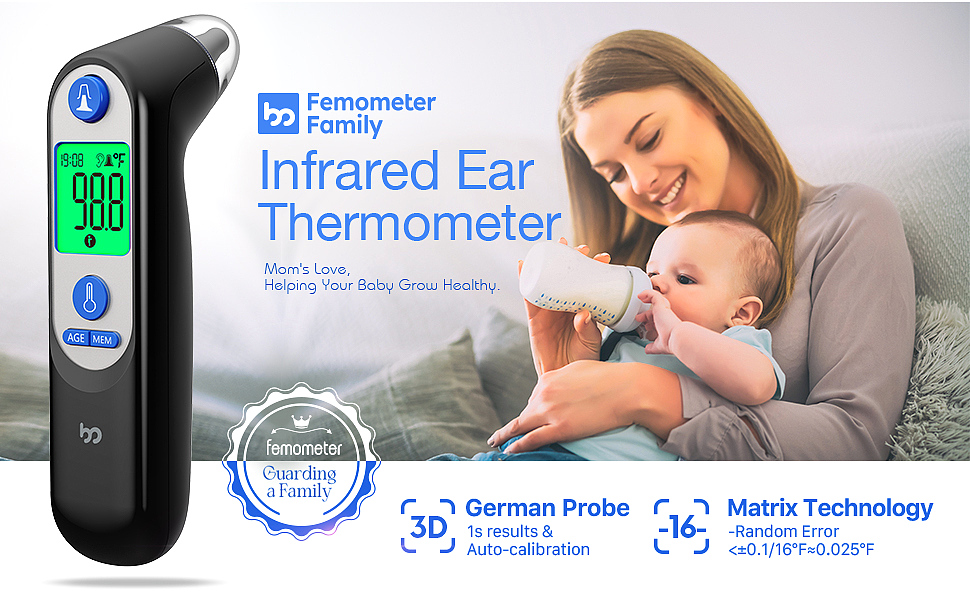
This anatomical advantage is why devices like the femometer family FC-IR109 Ear Thermometer focus exclusively on this site. By targeting the tympanic membrane, these instruments bypass the thermal lag associated with other measurement sites, offering a near real-time snapshot of the body’s internal status.
Photons and Physics: How Infrared Detection Works
How does a device measure temperature without contact with the membrane itself? The principle relies on infrared (IR) radiation. Physics dictates that any object with a temperature above absolute zero emits thermal radiation. The intensity of this radiation is directly proportional to the object’s temperature.
Modern ear thermometers function as sophisticated radiometers. They utilize a thermopile sensor to detect the infrared energy naturally emitted by the eardrum.
1. Detection: The sensor captures the IR flux.
2. Conversion: A microprocessor converts this energy signal into an electrical signal.
3. Calculation: Algorithms compensate for ambient temperature and convert the signal into a readable temperature value.
This entire sequence occurs in milliseconds. For instance, the FC-IR109 utilizes a high-sensitivity sensor chip to execute this calculation in approximately one second. This speed is not merely a convenience; it is a clinical asset, minimizing the distress of a sick child and reducing the variable of patient movement.
The Vital Role of Hygiene Caps: Optics and Safety
A common point of friction for new users of ear thermometers is the requirement for disposable probe covers (hygiene caps). While often viewed as an ongoing cost, from a medical engineering perspective, they are non-negotiable for two reasons: Infection Control and Optical Integrity.
- Infection Control: The ear canal can harbor bacteria and viruses. Without a disposable barrier, a thermometer becomes a vector for cross-contamination between family members—passing an ear infection from a child to a sibling, for example.
- Optical Integrity: Infrared sensors are optical devices, similar to a camera lens. Earwax (cerumen) is opaque to infrared radiation. Even a microscopic smear of oil or wax on the sensor lens can obstruct the IR signal, leading to artificially low, inaccurate readings.
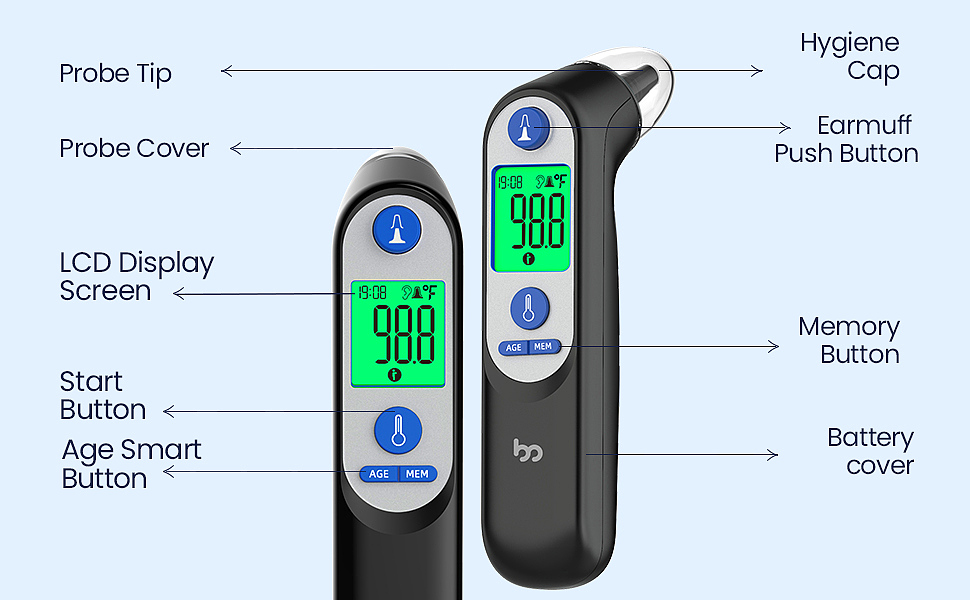
The design of the FC-IR109 addresses this by mandating the use of hygiene caps (supplied with the unit). The cap acts as a calibrated window—transparent to infrared waves but impervious to biological contaminants. Its quick-ejection mechanism allows the user to discard the potential biohazard without touching it, preserving both the sterile environment and the precision of the sensor lens.

Interpreting the Data: Fever is Dynamic
A number on a screen is data; understanding it is insight. Fever thresholds are not static; they vary by age and measurement site. A temperature that is normal for an active toddler might be elevated for an adult.
Advanced digital thermometers attempt to bridge this gap between raw data and actionable information.
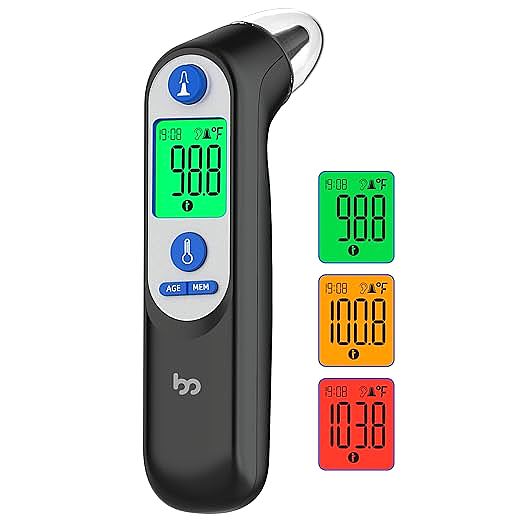
* Visual Triage: Color-coded backlights—Green (Normal), Orange (Elevated), Red (High)—act as an immediate visual triage system. This is particularly valuable during night checks when cognitive processing is slowed by fatigue.
* Longitudinal Tracking: Illness is a trajectory, not a single point. Features like the 30-reading memory recall allow caregivers to observe the trend. Is the fever responding to medication? Is it spiking at specific times?
By offering age-specific modes (Infant, Child, Adult), devices like the FC-IR109 adjust their algorithmic interpretation to provide contextually relevant alerts, reducing the “fever phobia” that often grips anxious parents.

Conclusion: Empowered Caregiving
The evolution of home medical equipment has shifted the power dynamic in healthcare. We no longer need to wait for a clinical appointment to obtain vital signs. Tools grounded in the physics of infrared thermometry and the anatomy of the tympanic membrane offer professional-grade insights within the home.
However, technology is a partner, not a magician. Accuracy depends on understanding the tool: straightening the ear canal to ensure a direct line of sight to the eardrum, using a clean probe cover every time, and interpreting the results within the context of the patient’s age and behavior. When combined with this knowledge, modern ear thermometers become more than just gadgets; they become essential instruments of proactive family health.
