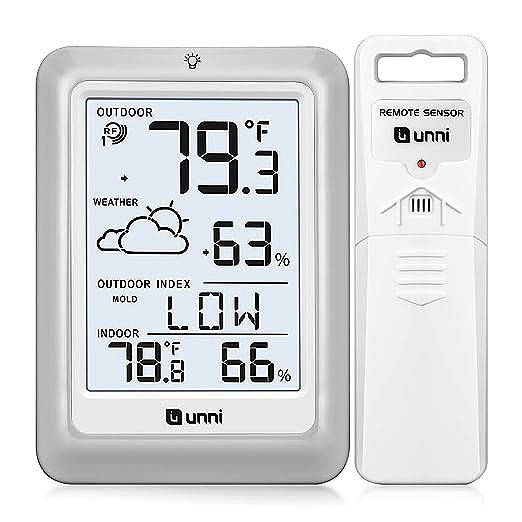
We inhabit invisible microclimates. Walk from a sun-drenched kitchen to a subterranean basement, and you are traversing distinct atmospheric zones. Yet, our perception of these zones is often limited to vague sensations—”it feels muggy” or “it’s a bit chilly.” In the age of smart homes, relying on subjective feeling is an obsolete method for managing property health and personal comfort.
To truly optimize our living environment, we must transition from passive observation to active environmental telemetry. This involves measuring not just temperature, but the complex interplay of humidity, dew point, and thermal retention. Advanced monitoring stations, such as the U UNNI UN0581 Wireless Weather Station, have democratized access to this data, employing industrial-grade sensing technology to turn invisible atmospheric dynamics into actionable intelligence.

The Anatomy of Accuracy: Why the Sensor Matters
In the world of digital hygrometers, not all sensors are created equal. The market is flooded with generic resistive sensors that drift significantly with age and temperature fluctuations. Precision demands a different architecture.
High-fidelity devices like the UN0581 distinguish themselves by integrating Swiss-made Sensirion sensors. Sensirion is a benchmark in the industry, known for its CMOSens® technology which combines the sensor element and signal processing circuitry on a single chip.
* Capacitive Stability: Unlike resistive sensors, these capacitive humidity sensors offer superior long-term stability and faster response times to humidity changes (hysteresis).
* Calibration Standards: The specified accuracy of ±0.5°F and ±2% RH moves the device from the realm of “novelty toy” to “diagnostic tool.” This precision is critical when calculating derived metrics like Dew Point, where even small errors in primary data can lead to large deviations in the result.
Beyond Relative Humidity: The Dew Point Imperative
Most homeowners fixate on Relative Humidity (RH), but RH is a moving target. It is “relative” to temperature. Warm air holds more moisture; cool air holds less. This is why 50% humidity feels comfortable in winter but oppressive in summer.
To truly understand moisture—and the risk of mold—we must look to the Dew Point.
* The Absolute Metric: Dew Point is the temperature at which the air becomes fully saturated (100% RH). It is an absolute measure of the water vapor burden in the air.
* The Condensation Threshold: If the surface temperature of your windows or basement walls drops below the Dew Point, condensation forms immediately. This is the genesis of structural damage.
A comprehensive weather station calculates and displays this metric. By monitoring Dew Point, you gain predictive power. If the Dew Point creeps above 65°F (18°C), you know the environment is becoming critical for mold growth and human discomfort, signaling the immediate need for dehumidification, regardless of what the “temperature” says.

The Algorithm of Health: Interpreting the Mold Index
Mold is biological, but its prerequisites are physical. It requires specific conditions of temperature and moisture persistence to germinate. Advanced monitoring units process environmental data to generate a Mold Index.
This is not a biological detector (it doesn’t “smell” mold); rather, it is a risk assessment algorithm. By continuously correlating indoor humidity trends with temperature over time, the device calculates the probability of microbial growth.
* Zero to Low Risk: Conditions are too dry or transient for spore activation.
* High Risk: The environment has sustained high humidity (high water activity) for a duration sufficient for fungal colonization.
For areas like basements, attics, or musical instrument storage rooms, this index serves as an early warning system, prompting intervention before the first spore blooms.
RF Physics: Optimizing Wireless Telemetry
Wireless weather stations rely on Radio Frequency (RF) transmission (typically 433MHz or 915MHz) to bridge the gap between the outdoor sensor and the indoor console. While specifications may list a range of 330ft (100m), this is a “Line of Sight” theoretical maximum.
Real-World Propagation:
In a residential structure, signals must penetrate stucco (often containing wire mesh), brick, low-E glass (metal coated), and interference from Wi-Fi networks.
* Placement Strategy: To maximize reliability, place the remote sensor vertically (to shed rain) and ideally on a wooden surface rather than metal siding, which can act as a Faraday cage or ground plane, attenuating the signal.
* Thermal Shielding: Never place an outdoor sensor in direct sunlight. Solar radiation will heat the sensor housing, creating a microclimate significantly hotter than the ambient air. The ideal location is under a north-facing eave, ensuring the data reflects the true air temperature, not the solar load.

Data-Driven Home Management
Equipped with precise telemetry, home management shifts from reactive to proactive.
* HVAC Efficiency: By monitoring the difference between indoor and outdoor readings, you can determine the exact moment to open windows for natural cooling versus running the AC.
* Garden Protection: Remote sensors allow gardeners to monitor microclimates. A frost alert from a sensor placed near sensitive hydrangeas can save a season’s worth of growth.
* Health Preservation: Maintaining indoor humidity between 40-60% is proven to support respiratory mucous membranes and reduce viral transmission rates.

Conclusion: The Informed Environment
The modern home is a complex thermodynamic system. Understanding it requires more than intuition; it requires data. Devices like the U UNNI UN0581 represent a shift towards accessible, high-precision environmental awareness. By leveraging Swiss sensing technology and understanding critical metrics like Dew Point and Mold Risk, we empower ourselves to create living spaces that are not only more comfortable but fundamentally healthier and more resilient.
